Edexcel IGCSE Economics 4EC1 Exam Structure
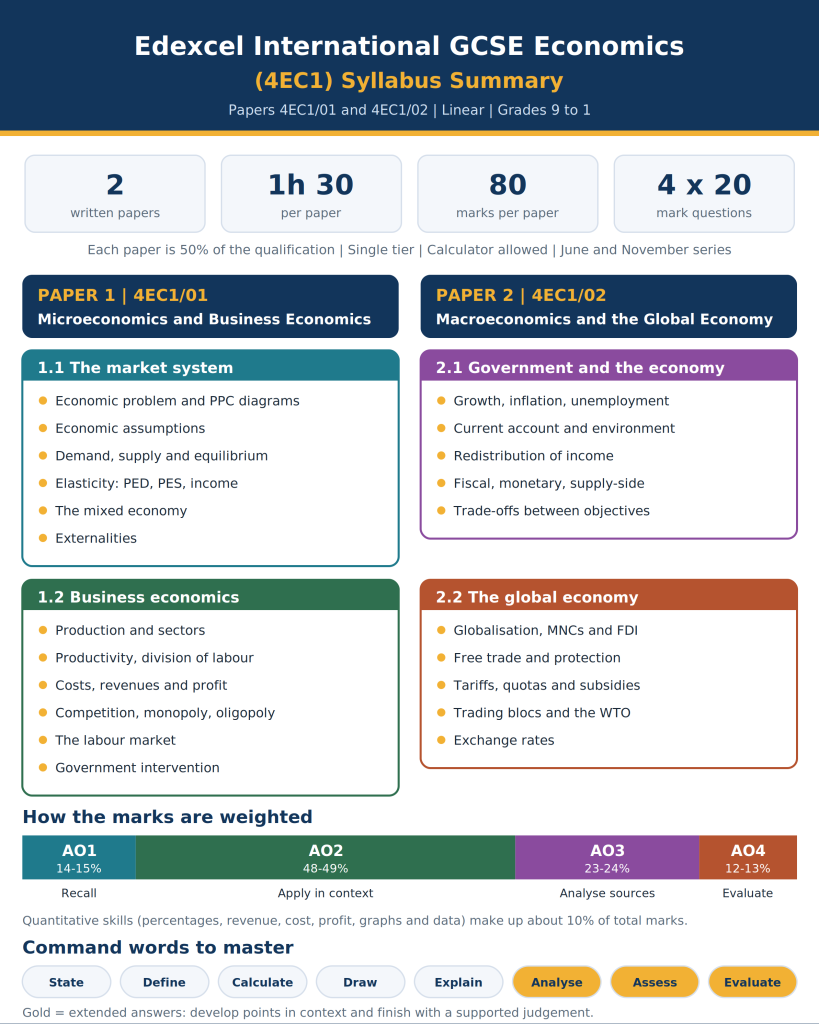
The Pearson Edexcel International GCSE in Economics (4EC1) is a linear qualification assessed by two written papers at the end of the course. Each paper lasts 1 hour 30 minutes, is worth 80 marks and counts for 50% of the final grade. Both papers contain four compulsory 20-mark questions, mixing multiple-choice, short-answer, data response and open-ended questions. Grades are awarded from 9 to 1.
Paper 1 (4EC1/01) covers Microeconomics and Business Economics. Paper 2 (4EC1/02) covers Macroeconomics and the Global Economy. Papers are available in paper-based or onscreen format, and the exam series are June and November.
Why Practice with 4EC1 Past Papers
Past papers show you how Pearson asks questions, how marks are awarded and how much detail a full-mark answer needs. Because each paper has only four large questions, every topic carries real weight. Practising under timed conditions helps you spot weak areas early, build speed on calculations and diagrams, and learn to finish extended answers with a clear judgement.
Almost half the marks reward applying economic knowledge in context, and around a quarter reward analysing information from sources. Regular past paper practice trains exactly these skills.
Paper 1 Past Papers: Microeconomics and Business Economics
Paper 1 tests the market system and business economics. Expect questions on the economic problem and production possibility curves, demand, supply and market equilibrium, elasticity, the mixed economy and externalities. You will also be tested on production, productivity and division of labour, costs, revenues and profit, business competition, the labour market and government intervention.
Typical skills include drawing and labelling supply and demand diagrams, calculating price elasticity of demand, working out revenue, costs and profit, and evaluating the effects of government intervention.
Paper 2 Past Papers: Macroeconomics and the Global Economy
Paper 2 tests how whole economies work and how they connect. Topics include economic growth, inflation, unemployment, the current account, environmental protection and the redistribution of income. It also covers fiscal, monetary and supply-side policy, the trade-offs between government objectives, globalisation, multinational corporations, international trade and protection, trading blocs and the WTO, and exchange rates.
Typical skills include interpreting economic data, explaining policy impacts, and evaluating which policy best achieves a given objective.
How to Use Past Papers to Improve Your Economics Grade
Start with topic practice, then move to full timed papers once your knowledge is secure. Aim for roughly 18 to 20 minutes per 20-mark question, and mark your work strictly against the official mark scheme. Keep a log of lost marks, noting whether each came from a knowledge gap, a missed command word, a weak diagram or a calculation slip, and review it weekly.
Learn the Command Words
Master the command words early. State, define, calculate, draw and explain reward precise, structured answers, while analyse, assess and evaluate need developed arguments in context and a supported conclusion.
Which 4EC1 Past Papers to Practice First
Work from the most recent June and November papers first, then move backwards. Papers from before June 2019 belong to the previous specification (4EC0), so use them for topic practice rather than full timed papers. Specimen papers are useful for mock exams.