AQA A-Level Further Maths (7367) Past Papers
Are you aiming for top marks in your AQA A-Level Further Mathematics (7367) mock or final examinations in 2027? Practicing with real exam papers is the single best way to transition from basic textbook exercises to multi-step exam problem-solving. AQA Further Maths tests deep logical reasoning across core modules—including Complex Numbers, Matrices, Proof by Induction, Hyperbolic Functions, Differential Equations, and Polar Coordinates—alongside optional routes in Mechanics, Statistics, and Discrete Mathematics. Working through full-length practice papers under strict timed conditions forces you to develop algebraic speed, construct watertight mathematical proofs, and avoid dropping easy method marks. By analyzing step-by-step mark schemes after every attempt, you can spot subtle integration errors, master matrix transformations, and refine your exam approach to confidently secure an $A^*$.
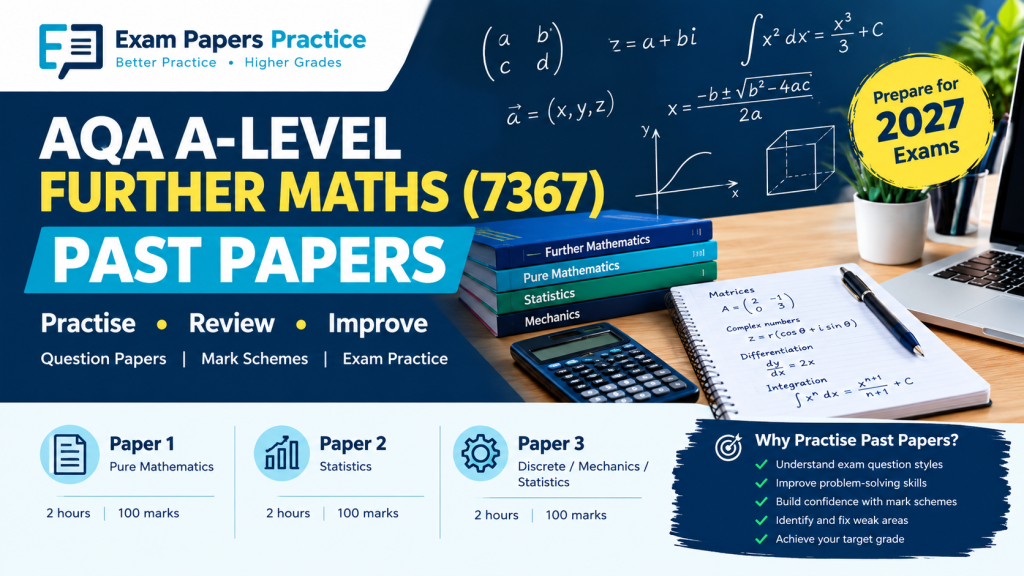
At Exam Papers Practice, we supply students, tutors, and schools with free, downloadable AQA A-Level Further Maths past papers, mark schemes, and worked solutions. Our organized repository simplifies your revision workflow, allowing you to isolate specific paper components—whether you need pure mathematics practice for Paper 1 and Paper 2 or targeted revision for Paper 3 options. Teachers can utilize these official materials for mock creation and classroom diagnostics, while independent learners can track their progress against official examiner standards. Integrating these specification-aligned papers into your study routine helps you master calculator techniques, understand mark allocation for complex derivations, and prepare effectively for 2027 assessments.
Please be guided that we provide 1 free resource for you to have a grasp of what you can expect to get when you will subscribe to us to revise by topic and exam board with mark scheme
May / June 2026 AQA A Level Maths (7367) Past Papers
2025 Past Papers
2019 Past Papers
Specimen Papers
AQA A-Level Further Mathematics (7367) 2026 Past Papers, Revision Notes & Exam Guide
Prepare for your AQA A-Level Further Mathematics (7367) 2026 Past Papers with focused revision, exam practice and mark scheme guidance at Exam Papers Practice. Whether you are preparing for 2027 mock exams or final A-Level examinations, practising past papers can help you understand examination requirements, strengthen mathematical reasoning, improve problem-solving techniques and work towards your target grade. Use question papers alongside mark schemes, topic revision and timed practice to identify weaknesses and build confidence with challenging mathematical problems.
AQA A-Level Further Mathematics (7367) Exam Overview
AQA A-Level Further Mathematics is a linear qualification assessed through three written examination papers at the end of the course. Each paper lasts 2 hours, carries 100 marks and contributes approximately 33⅓% towards the overall A-Level grade. The qualification develops advanced mathematical techniques, logical reasoning, proof, modelling and problem-solving skills.
| Exam component | Main content | Duration | Marks | Weighting |
|---|---|---|---|---|
| Paper 1 | Core Further Mathematics | 2 hours | 100 | 33⅓% |
| Paper 2 | Core Further Mathematics | 2 hours | 100 | 33⅓% |
| Paper 3 | Two selected optional applications | 2 hours | 100 | 33⅓% |
| Total | Full A-Level qualification | 6 hours | 300 | 100% |
Source: Official AQA A-Level Further Mathematics specification.
AQA Further Mathematics Paper 1: Core Content
Paper code: 7367/1
Paper 1 assesses the compulsory core content of AQA A-Level Further Mathematics. Questions can range from short, single-mark calculations to multi-step problems that require students to connect different mathematical techniques.
Key revision areas include:
Mathematical proof and rigorous mathematical arguments.
Complex numbers and their applications.
Matrices and matrix operations.
Further algebra and functions.
Further differentiation and integration.
Further vectors and geometrical applications.
Polar coordinates and their properties.
Hyperbolic functions.
Differential equations.
Numerical methods and approximations.
Practise AQA Further Mathematics Paper 1 past papers to improve algebraic accuracy, show clear working and select suitable methods for unfamiliar problems.
AQA Further Mathematics Paper 2: Core Content
Paper code: 7367/2
Paper 2 also assesses the compulsory core content. The specification allows the core topics to be assessed across both Paper 1 and Paper 2, so students should revise the entire core specification rather than treating individual topics as exclusive to one paper.
Prioritise complex numbers, matrices, further calculus, differential equations, numerical methods, vectors, polar coordinates, hyperbolic functions, algebra and proof. Practise questions that combine multiple topics, as advanced problems often require several stages of reasoning before reaching a final answer.
Use past papers and mark schemes to identify where errors occur, whether through incorrect algebra, a poorly chosen method, incomplete reasoning or inaccurate final answers.
AQA Further Mathematics Paper 3: Optional Applications
Paper code: 7367/3
Paper 3 assesses two optional applications selected from the three available options: Mechanics, Statistics and Discrete Mathematics. Your school or college determines the route you study, so check your course specification before selecting revision papers.
| Paper 3 route | Optional applications |
|---|---|
| Route 1 | Discrete Mathematics and Statistics |
| Route 2 | Statistics and Mechanics |
| Route 3 | Mechanics and Discrete Mathematics |
Paper 3 lasts 2 hours, carries 100 marks and contributes approximately 33⅓% of the qualification. It includes questions requiring mathematical application, interpretation and problem-solving.
Use the past papers that match your chosen options. Practising an unfamiliar optional route will not replace revision of the applications you have actually studied.
Complete AQA A-Level Further Mathematics (7367) Specification Summary
Use the following table to organise revision across the compulsory core and optional applications. For full topic requirements, consult the official AQA Further Mathematics specification.
| Specification area | Key topics to revise |
|---|---|
| Mathematical proof | Proof by deduction, proof by exhaustion and proof by contradiction, where specified |
| Complex numbers | Complex arithmetic, Argand diagrams, modulus, argument and complex number representations |
| Matrices | Matrix operations, determinants, inverses and transformations |
| Further algebra and functions | Advanced algebraic techniques, functions and mathematical relationships |
| Further calculus | Differentiation, integration and applications |
| Further vectors | Vector methods and geometrical applications |
| Polar coordinates | Polar representations and related calculus |
| Hyperbolic functions | Hyperbolic identities, functions and calculus |
| Differential equations | Forming and solving differential equations and interpreting solutions |
| Numerical methods | Numerical solution techniques, iterative methods and approximation |
| Mechanics option | Advanced mechanics concepts, forces, motion and mathematical modelling |
| Statistics option | Probability distributions, statistical methods and inference |
| Discrete Mathematics option | Discrete structures, algorithms, networks and related mathematical techniques |
Important: Proof, problem-solving and mathematical modelling are overarching themes throughout the qualification. Paper 3 assesses the two optional applications studied on your course.
Detailed Topic Breakdown for AQA Further Mathematics
1. Mathematical Proof
Proof is an important part of advanced mathematics. You should be able to construct logical arguments, use correct notation and justify why a statement is true.
Proof by deduction: Use established mathematical facts and logical steps to reach a conclusion.
Proof by exhaustion: Examine all relevant cases when the method is appropriate.
Proof by contradiction: Assume the opposite of the required statement and demonstrate a contradiction.
Mathematical notation: Present expressions, statements and conclusions precisely.
When practising proof questions, make sure every step follows logically from the previous one. A correct final statement may not earn full credit if the supporting argument is incomplete.
2. Complex Numbers
Complex numbers extend the number system beyond real numbers and are used in many advanced mathematical problems.
Arithmetic involving complex numbers.
Real and imaginary parts.
Modulus and argument.
Argand diagrams and geometrical interpretation.
Complex number representations and related algebraic techniques.
Practise converting between representations where required and check signs carefully when multiplying, dividing or manipulating complex expressions.
3. Matrices
Matrix methods help represent and solve mathematical problems efficiently.
Matrix addition and multiplication.
Determinants and inverse matrices.
Matrix transformations and their effects.
Using matrices in multi-step problems.
Pay close attention to matrix dimensions and the order of multiplication. Check your calculations and understand when a matrix inverse exists.
4. Further Algebra, Functions and Calculus
These topics develop techniques beyond standard A-Level Mathematics and often require accurate algebra alongside a clear understanding of mathematical relationships.
Further algebraic manipulation and functions.
Differentiation and integration techniques.
Applications of calculus to mathematical problems.
Relationships between functions, derivatives and integrals.
Combining calculus with other core topics.
Show intermediate steps rather than jumping straight to an answer. This helps you check your method and makes it easier to identify where an error has occurred.
5. Further Vectors and Polar Coordinates
Further vectors and polar coordinates extend your ability to describe geometry and mathematical relationships.
Vector representations and operations.
Geometrical applications of vectors.
Polar coordinates and their relationship to Cartesian coordinates.
Calculus involving polar representations, where required.
Practise interpreting diagrams and expressing your reasoning clearly. Check that your final answers are consistent with the conditions given in each question.
6. Hyperbolic Functions, Differential Equations and Numerical Methods
These areas require students to select suitable techniques and apply them accurately.
Hyperbolic functions and identities.
Differentiation and integration involving hyperbolic functions.
Forming and solving differential equations.
Interpreting mathematical solutions.
Numerical approximation and iterative methods.
Understanding the accuracy and limitations of numerical answers.
When solving numerical questions, keep sufficient precision during intermediate calculations and follow the question’s instructions on accuracy.
7. Mechanics Option
Students who study Mechanics should practise applying mathematical methods to motion and physical systems.
Depending on the precise specification content taught, revision may include forces, kinematics, dynamics, modelling assumptions and equations describing physical motion.
Identify known quantities and the quantity required.
Draw and label appropriate diagrams.
Choose relevant equations and explain the steps in your calculation.
Check signs, units and assumptions.
Interpret the result in the context of the problem.
Use Mechanics Paper 3 past papers if Mechanics is one of your selected applications.
8. Statistics Option
The Statistics option develops advanced methods for analysing data, probability and statistical problems.
Revision should cover the Statistics content specified by AQA and taught on your course, including relevant probability distributions, statistical techniques and inference.
Identify the appropriate statistical method.
Use probability notation accurately.
Apply relevant formulae and calculations.
Interpret results in context.
State conclusions carefully and distinguish evidence from assumptions.
Practise Statistics questions using the methods and notation expected by your course, and check your conclusions against the question’s requirements.
9. Discrete Mathematics Option
Discrete Mathematics develops techniques for solving problems involving discrete structures and systematic methods.
Depending on your course coverage, revision may include algorithms, networks, discrete structures and related mathematical processes specified by AQA.
Identify the structure of the problem.
Select a suitable algorithm or method.
Record each stage of your working clearly.
Check that the result satisfies the stated conditions.
Explain the reasoning behind your solution.
Use Discrete Mathematics Paper 3 past papers if Discrete Mathematics is one of your selected applications.
AQA Further Mathematics Assessment Objectives
Understanding the assessment objectives helps you prepare for the different skills tested in AQA A-Level Further Mathematics.
AO1 – Use and Apply Standard Techniques: Recall mathematical facts, definitions and formulae, and carry out procedures accurately.
AO2 – Reason, Interpret and Communicate Mathematically: Construct logical arguments and proofs, make deductions, assess reasoning and use correct mathematical notation.
AO3 – Solve Problems: Translate problems into mathematical processes, use mathematical models, interpret solutions and consider their accuracy or limitations where appropriate.
The overall approximate weighting is 50% AO1, 25% AO2 and 25% AO3. Paper 3 places greater emphasis on problem-solving than Papers 1 and 2, so practising application-based questions is especially important.
For more detail, visit the official AQA scheme of assessment.
Common Mistakes in AQA A-Level Further Mathematics Exams
1. Making algebraic errors
The mistake: Losing a negative sign, expanding brackets incorrectly or simplifying an expression inaccurately.
The solution: Write each important step clearly, check signs and brackets, and substitute results back into the original expression where possible.
2. Showing insufficient working
The mistake: Writing only the final answer or skipping key stages in a multi-step calculation.
The solution: Show the method, intermediate results and mathematical reasoning. Clear working can help you identify mistakes and demonstrate the techniques you used.
3. Using the wrong method
The mistake: Applying a familiar formula or procedure without checking whether it fits the question.
The solution: Identify what the question asks, list the relevant information and choose a method suited to the problem. Practise unfamiliar questions that require you to combine topics.
4. Giving incomplete proofs
The mistake: Making a claim without fully justifying the logical steps.
The solution: Structure your proof carefully, state relevant assumptions and explain why each step follows. Finish with a clear conclusion.
5. Rounding too early
The mistake: Using rounded intermediate values and allowing small errors to affect the final answer.
The solution: Keep sufficient precision throughout your working and round only when appropriate, following the instructions in the question.
6. Neglecting the selected Paper 3 options
The mistake: Revising general Mathematics or core Further Mathematics while overlooking one of the optional applications.
The solution: Confirm whether your course includes Mechanics, Statistics, Discrete Mathematics or the relevant pair. Practise questions from both of your selected options.
7. Poor time management
The mistake: Spending too long on one challenging question and rushing later questions.
The solution: Practise full papers under timed conditions. Allocate time sensibly, move on when necessary and return to difficult questions if time permits.
How to Structure Strong Mathematical Solutions
A clear method is essential for advanced Further Mathematics questions. Use the following approach when practising:
Identify the task: Read the question carefully and note what must be calculated, proved or explained.
Choose a method: Identify the relevant formula, theorem or mathematical technique.
Show your working: Present calculations and reasoning in a logical order.
Check intermediate steps: Look for algebraic errors, incorrect signs and inappropriate assumptions.
Interpret the answer: Where relevant, explain what the result means in the context of the question.
Check the final result: Review accuracy, notation and any required units or rounding.
Adapt your approach to the actual question. Proofs, numerical calculations, modelling questions and optional application problems may require different solution structures.
How to Revise Effectively for AQA A-Level Further Mathematics (7367)
Phase 1: Master the specification
Review the complete core content and identify your selected Paper 3 options. Use topic notes, worked examples, formula practice and active recall to strengthen your understanding.
Phase 2: Practise topic-based questions
Start with individual topics such as complex numbers, matrices, calculus or proof. Once you are confident with the basic methods, progress to questions that combine different techniques.
Phase 3: Complete timed past papers
Attempt AQA Further Mathematics Papers 1 and 2, followed by Paper 3 questions that match your selected options. Practise under realistic conditions, allowing two hours per paper.
Phase 4: Review mark schemes
Compare your solutions with the relevant mark schemes. Identify missing steps, incorrect methods, weak mathematical reasoning and recurring calculation errors. Keep an error log and revisit questions you previously found difficult.
Phase 5: Retest weak areas
After reviewing your mistakes, solve similar questions without looking at the worked solution. Repeating this process helps you check whether you can apply the method independently.
When Should You Start Using AQA Further Mathematics Past Papers?
Early revision: Review the specification, consolidate core techniques and practise questions topic by topic.
Mid-stage preparation: Work on multi-step problems, proof and your selected optional applications.
Final preparation: Complete full timed papers, review mark schemes and concentrate on recurring weaknesses.
Before 2027 mocks: Practise under examination conditions and make sure you are revising the correct specification and Paper 3 route.
For students preparing for 2027 mock exams and final examinations, a combination of topic-based practice, timed papers and careful review can make revision more structured and purposeful.
Frequently Asked Questions: AQA A-Level Further Mathematics (7367)
Where can I find AQA A-Level Further Mathematics (7367) 2026 past papers?
Visit Exam Papers Practice – AQA A-Level Further Maths Past Papers to explore relevant revision resources. For official question papers, mark schemes and examiner reports released by AQA, use the AQA Further Mathematics assessment resources. Availability depends on the materials published for each examination series.
How many papers are in AQA A-Level Further Mathematics (7367)?
There are three written examination papers. Each lasts two hours and is worth 100 marks, contributing approximately one-third of the overall A-Level grade.
What topics are covered in AQA Further Mathematics 7367?
The compulsory core includes proof, complex numbers, matrices, further algebra and functions, further calculus, further vectors, polar coordinates, hyperbolic functions, differential equations and numerical methods. Students also study two optional applications from Mechanics, Statistics and Discrete Mathematics.
What is Paper 3 in AQA Further Mathematics?
Paper 3 assesses two optional applications selected for your course. The available combinations are Discrete Mathematics and Statistics, Statistics and Mechanics, or Mechanics and Discrete Mathematics. Check your school’s selected route before practising optional papers.
Are 2026 past papers useful for 2027 mock exams?
Yes. Relevant past papers can help you practise question styles, improve time management, test mathematical techniques and learn how marks are awarded. Always check that the questions and resources match the specification and optional applications you are studying.
How can I improve my AQA Further Mathematics grade?
Practise regularly, show complete working, review mark schemes and correct recurring errors. Strengthen your understanding of proof and mathematical reasoning, practise multi-step problems and complete timed papers covering both the core content and your selected Paper 3 options.
Where can teachers and schools find Further Mathematics resources?
Teachers and schools can use AQA’s official specification and assessment resources to support lesson planning, revision, practice assessments and feedback. Exam Papers Practice can complement classroom preparation by helping students organise their revision and practise examination-style questions.
Prepare for Your 2027 Exams with Exam Papers Practice
Achieving your target grade in AQA A-Level Further Mathematics (7367) requires strong mathematical understanding, consistent practice and effective exam technique. Working through past papers, reviewing mark schemes and correcting mistakes can help you improve accuracy, strengthen your reasoning and become more confident with challenging questions.
At Exam Papers Practice, our online exam resources support students, teachers and schools with focused revision and exam preparation. Explore our AQA A-Level Further Mathematics (7367) 2026 Past Papers page to find relevant practice resources and build a structured revision routine for your 2027 mock exams and final examinations.
Start practising today and take the next step towards stronger exam performance.
Are You Having Trouble with Your AQA A-Level Further Maths Studies? Get the Help You Need Today
If you’re struggling with your AQA A-Level Further Maths studies and looking for extra support, why not consider hiring a tutor or enrolling in summer school or Easter revision services? Whether you’re aiming to boost your grades or better understand complex topics, targeted revision can make a big difference. Accessing the right resources is crucial, and there are multiple options available to help you succeed.
Why Consider a AQA A-Level Further Maths Tutor for Your Studies?
A personal tutor can provide tailored support based on your individual learning needs. Tutors offer one-on-one sessions that focus on the areas where you need the most improvement. Whether it’s mathematics, science, or language arts, a tutor can provide targeted strategies and techniques to ensure that you understand key concepts and are prepared for upcoming exams.
Summer School and Easter Revision Services: A Great Opportunity
Summer and Easter revision services are an excellent way to prepare for exams while still having time to relax. These sessions are structured to help you revisit your syllabus, revise key topics, and practice with exam papers. These services offer intensive study periods, which can be highly beneficial for students aiming to refresh their knowledge and boost confidence.
Accessing the Board AQA A-Level Further Maths (7367) Syllabus for Efficient Studying
Accessing your exam board’s syllabus is one of the most effective ways to stay on track during your revision. The syllabus provides a clear outline of the topics you need to cover and allows you to prioritize areas that require more attention.
The comprehensive AQA A-Level Further Maths (7367) Specification ensures that you are following the right path and studying the correct resource material.
Where to Find the Best Educational Services
For further support, you can check out services offered by our Sister Companies Lite Regal International College and Lite Regal Education, both of which provide expert tutors and revision resources. Whether you need a tutor for personalized lessons or are looking to join a revision group, these services have a wide range of options to fit your study needs.
Reaching an A* in AQA A-Level Further Maths (7367) is completely achievable—when you prepare the right way. With Exam Papers Practice, you’re not just reviewing facts—you’re training yourself to think like a top student.
Start by choosing one topic today. Try a few questions. Mark them. Reflect. Repeat.
Step by step, topic by topic, you’ll build confidence and sharpen your skills—and when exam day comes, you’ll be ready.
