OxfordAQA A Level Physics (9630) Past Papers for 2027 Exams and Beyond
Prepare for your OxfordAQA A Level Physics (9630) examinations with our collection of past papers, mark schemes and exam-focused revision resources. Designed to support students studying the International A Level Physics qualification, these resources help you strengthen your understanding of essential physics principles, practice examination questions and develop the analytical skills needed to perform confidently in your exams.
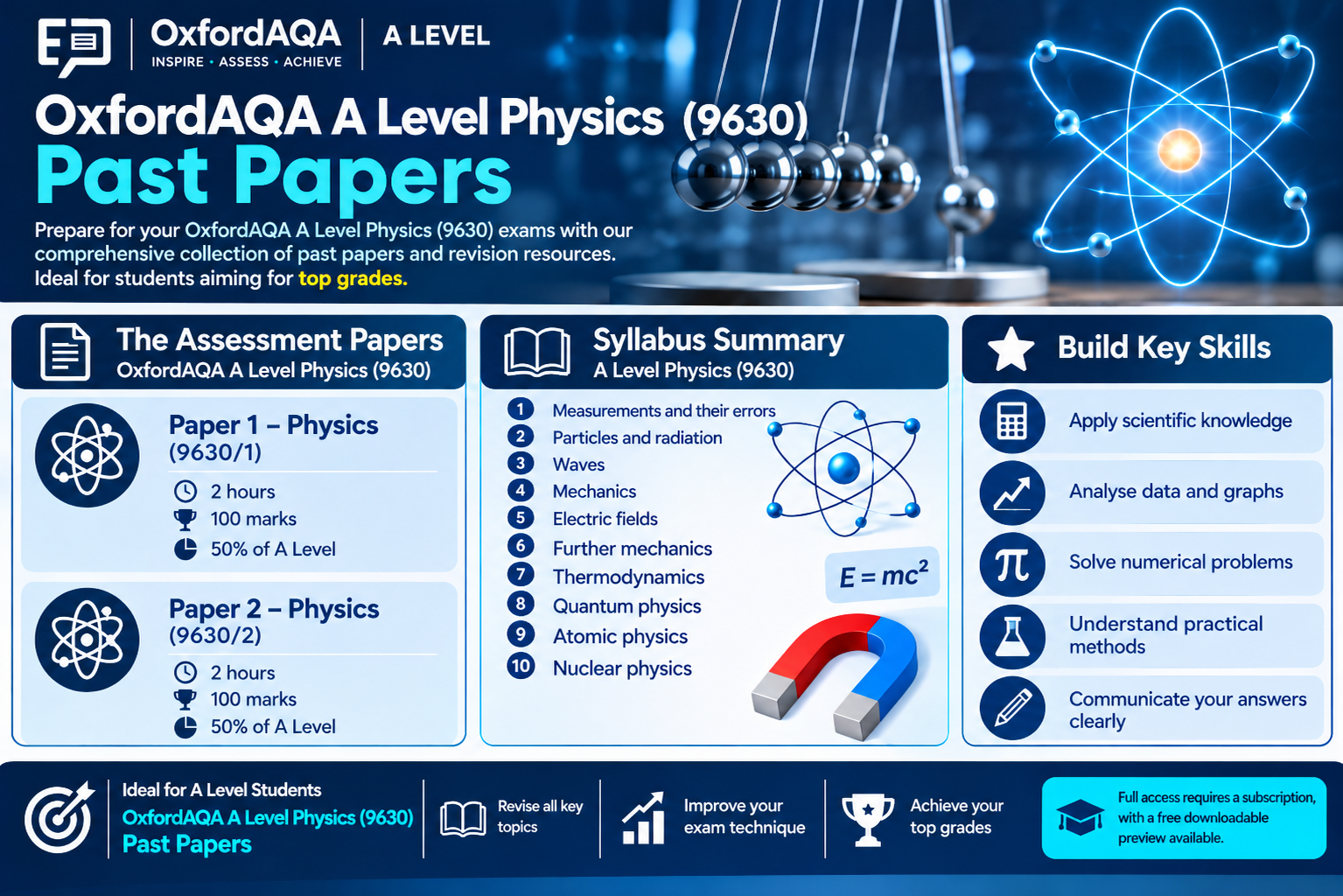
The OxfordAQA A Level Physics specification follows a modular structure consisting of five examination units. Students study topics ranging from mechanics, electricity and waves to gravitational fields, nuclear energy and practical physics. Each unit is assessed through a separate written examination, with all five units contributing equally towards the final A Level qualification.
Please note we have provided the 1st PDF as a free download as an example to see what you will get if you subscribe to our platform Exam Papers Practice.
OxfordAQA A Level Physics (9630) May/ June 2026 Past Paper Resources
OxfordAQA A Level Physics (9630) Jan 2026 Past Paper Resources
OxfordAQA A Level Physics (9630) May 2025 Past Paper Resources
OxfordAQA A Level Physics (9630) January 2025 Past Paper Resources
OxfordAQA A Level Physics (9630) May 2024 Past Paper Resources
OxfordAQA A Level Physics (9630) January 2024 Past Paper Resources
OxfordAQA A Level Physics (9630) Past Papers and Mark Schemes
Practicing past papers is an important part of preparing for your OxfordAQA A Level Physics examinations. Working through previous exam questions helps you become familiar with the assessment format, understand how physics concepts are tested and improve your ability to apply mathematical and scientific principles.
Our OxfordAQA Physics resources cover all five units of the specification, allowing you to organize your revision and focus on the topics assessed in each examination.
Unit 1: Mechanics, Materials and Atoms
Unit 1 introduces the fundamental principles of physics, covering measurements, mechanics, material properties, particles and radioactivity.
Key topics include:
Measurements and their errors
Scalars and vectors
Motion along a straight line and projectile motion
Newton’s laws of motion and momentum
Work, energy and power
Bulk properties of solids and Young modulus
Constituents of the atom and elementary particles
Radioactivity
Assessment: 2 hours | 80 marks | 20% of A Level
Unit 2: Electricity, Waves and Particles
Unit 2 explores electrical principles and the behavior of waves and particles. Students develop their understanding of electrical circuits, oscillations, wave phenomena and quantum physics.
Key topics include:
Basics of electricity and current-voltage characteristics
Resistivity and electrical circuits
Potential dividers
Electromotive force and internal resistance
Oscillating systems and resonance
Progressive waves and wave properties
Superposition, interference and diffraction
Refraction and stationary waves
Photoelectric effect and wave-particle duality
Assessment: 2 hours | 80 marks | 20% of A Level
Unit 3: Fields and Their Consequences
Unit 3 focuses on fields and their effects, including circular motion, gravitational fields, electric fields, capacitance and electromagnetic phenomena.
Key topics include:
Circular motion and simple harmonic motion
Newton’s law of gravitation
Gravitational field strength and potential
Orbits of planets and satellites
Coulomb’s law and electric field strength
Electric potential and capacitors
Capacitor charge and discharge
Exponential changes in radioactivity
Magnetic fields and electromagnetic induction
Alternating currents and transformers
Assessment: 2 hours | 80 marks | 20% of A Level
Unit 4: Energy and Energy Resources
Unit 4 examines energy transfer, thermal physics, nuclear processes and different energy resources. Students explore the physical principles behind energy generation and the behavior of gases.
Key topics include:
Energy transfer by heating and doing work
Conduction and radiation
Ideal gases and kinetic theory
Nuclear radius, mass and energy
Induced nuclear fission
Safety aspects of nuclear reactors
Nuclear fusion
Rotational motion
Wind and solar energy
Hydroelectric power and pumped storage
Assessment: 2 hours | 80 marks | 20% of A Level
Unit 5: Physics in Practice and Multiple Choice
Unit 5 assesses practical and analytical skills alongside knowledge from across the specification. It requires students to apply their understanding of physics to experimental situations, interpret data and answer synoptic questions.
Key areas include:
Practical skills and experimental techniques
Data analysis and interpretation
Evaluation of experimental results
Applying physics principles to unfamiliar situations
Multiple-choice questions
Synoptic questions drawing on the wider specification
Assessment: 2 hours | 80 marks | 20% of A Level
OxfordAQA A Level Physics (9630) Exam Structure
The OxfordAQA International A Level Physics qualification consists of five written examination papers. Each paper is worth 80 marks, lasts two hours and contributes 20% towards the final A Level result.
| Examination | Unit | Duration | Marks | A Level weighting |
|---|---|---|---|---|
| Paper 1 | Mechanics, Materials and Atoms | 2 hours | 80 | 20% |
| Paper 2 | Electricity, Waves and Particles | 2 hours | 80 | 20% |
| Paper 3 | Fields and Their Consequences | 2 hours | 80 | 20% |
| Paper 4 | Energy and Energy Resources | 2 hours | 80 | 20% |
| Paper 5 | Physics in Practice and Multiple Choice | 2 hours | 80 | 20% |
Practical knowledge and analytical skills are assessed through the written examinations, including the dedicated Physics in Practice unit.
Why Practice OxfordAQA A Level Physics Past Papers?
Regular exam practice can help you develop the knowledge and skills needed to tackle different types of physics questions. Using past papers and mark schemes can help you:
Understand the examination format: Become familiar with the structure, question styles and assessment requirements.
Strengthen problem-solving skills: Practice applying mathematical methods and physics principles to unfamiliar problems.
Improve calculation technique: Develop accuracy when working with equations, units and numerical data.
Develop practical and analytical skills: Practice interpreting experimental results, evaluating data and explaining scientific methods.
Identify areas for improvement: Use mark schemes to understand expected answers and recognize topics that need further revision.
Build exam confidence: Improve your time management and become more comfortable answering examination questions.
Struggling with Your OxfordAQA A Level Physics Revision?
Preparing for the OxfordAQA AS & A Level Physics exam can feel challenging — but you don’t have to face it alone. One of the most effective ways to strengthen your understanding and boost exam performance is by practicing with past papers. With the right approach and resources, you can build confidence, refine analytical skills, and maximize your score potential.
Why Use OxfordAQA A Level Physics (9630) Past Papers for Revision?
Past papers are a vital tool for mastering exam structure, timing, and question styles. They help you understand how questions are phrased, identify key topics, manage time effectively, and pinpoint areas needing extra practice. Past papers turn revision into active learning and prepare you for the challenges of the real exam.
Combine Past Papers with Expert Guidance
If certain topics feel difficult, working with a tutor or joining focused revision sessions can make a significant difference. One-on-one tutoring or small group classes provide step-by-step explanations for complex questions, personalized strategies tailored to your learning style, and exam-focused techniques to improve accuracy and speed. These sessions help transform confusion into clarity, making revision more efficient and effective.
How Past Papers Help You Master the OxfordAQA AS & A Level Physics (9630) Syllabus
The OxfordAQA AS & A Level Physics (9630) syllabus requires both conceptual understanding and practical skills. Using past papers helps you track progress, focus on weak areas, and become familiar with question types and marking schemes, ensuring your study time is focused on mastering exam-style problems.
Where to Find Reliable OxfordAQA A Level Physics Past Papers and Revision Resources
At Exam Papers Practice, we offer a complete range of past papers, topic questions, and revision resources carefully designed by subject experts. You can also explore support from our sister institutions Lite Regal International College and Lite Regal Education – both renowned for delivering premium tutoring and revision programs.
Success in OxfordAQA A Level Physics Exams doesn’t come from last-minute revision — it comes from consistent, smart practice. By solving past papers regularly, analyzing your mistakes, and improving your techniques, you’ll develop the skills, confidence, and precision needed to excel.