
AQA AS Level Psychology (7181) Past Papers
Are you preparing for your AS Level AQA Psychology mock exams or final examinations in 2027? Using AS LEVEL AQA Psychology (7181) 2026 Past Papers as part of your revision can help you become familiar with the examination format, understand how questions are structured and learn how to apply psychological theories, research studies and key concepts effectively. Whether you are revising Social Influence, Memory, Attachment, Approaches in Psychology, Clinical Psychology and Mental Health, or Research Methods, regular past paper practice can help you identify gaps in your knowledge and focus your revision where it matters most. By answering questions under timed conditions and carefully reviewing the official mark schemes, you can improve your written responses, strengthen your evaluation skills, develop confidence with research methods and mathematical questions, and avoid common mistakes that cost valuable marks. As you prepare for your 2027 mock exams and final AS Level examinations, make past papers a regular part of your study routine. Combined with focused topic revision, active recall and careful analysis of your mistakes, they can help you build a stronger understanding of the AQA Psychology specification and work towards achieving your target grade.
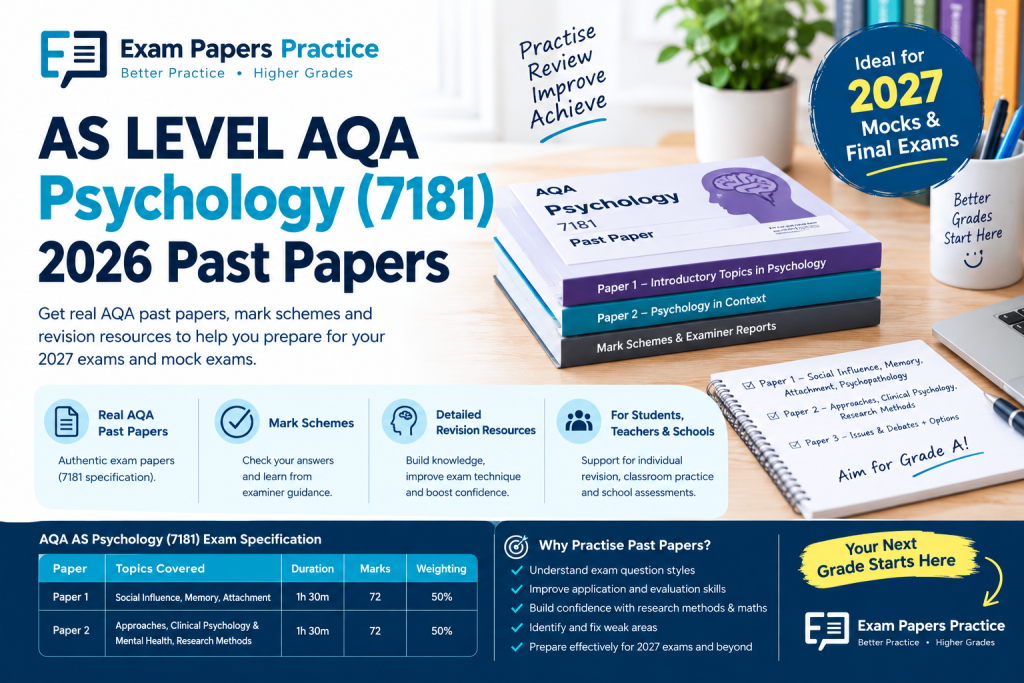
Our AS LEVEL AQA Psychology (7181) 2026 Past Papers are a valuable revision resource for students preparing for their 2027 mock exams and final AS Level examinations. Practising authentic AQA past papers helps you become familiar with the exam format, understand question styles and develop the skills needed to apply psychological theories, explain key concepts and evaluate research studies effectively. Whether you are revising Social Influence, Memory, Attachment, Approaches in Psychology, Clinical Psychology and Mental Health, or Research Methods, working through exam-style questions can help you identify knowledge gaps, improve your written answers and focus your revision on areas that need more attention. By completing papers under timed conditions and checking your responses against the relevant mark schemes, you can understand how marks are awarded, strengthen your evaluation skills, improve your confidence with research methods and mathematical questions, and avoid common mistakes that can cost valuable marks. At Exam Papers Practice, our online exam resources support students, teachers and schools with more focused preparation, helping learners build a stronger understanding of the AQA Psychology (7181) specification and work towards their target grades. Make AS LEVEL AQA Psychology (7181) 2026 Past Papers part of your regular revision routine to prepare more confidently for your 2027 exams and mocks.
Please note we have provided the 1st PDF as a free download as an example to see what you will get if you subscribe to our platform Exam Papers Practice.
May / June 2026 AQA AS Level Psychology (7181) Past Papers
May / June 2019 AQA AS Level Psychology (7181) Past Papers
May / June 2018 AQA AS Level Psychology (7181) Past Papers
May / June 2017 AQA AS Level Psychology (7181) Past Papers
AQA AS-Level Psychology (7181) Past Papers, Revision Notes & Exam Guide
Master your preparation for the AQA AS-Level Psychology (7181) qualification with official past papers, spec-aligned mark schemes, and target-driven revision strategies. Whether you are preparing for upcoming mock exams or final assessments in 2027 and beyond, using real exam papers under timed conditions is the single most effective strategy to improve your exam technique, master mathematical queries, and secure a Grade A.
AQA AS-Level Psychology (7181) Exam Overview & Papers
The AQA AS Psychology 7181 qualification is assessed across two compulsory written examination papers, each lasting 1 hour and 30 minutes. Practicing full-length AQA AS Psychology 7181 past papers enables you to develop speed, master scenario application (AO2), and format top-band 12-mark evaluation essays (AO3).
AQA AS-Level Psychology Paper 1: Introductory Topics in Psychology
Paper 1 (Code: 7181/1) evaluates core introductory concepts across three key modules: Social Influence, Memory, and Attachment.
Exam Structure: 72 marks | 1 hour 30 minutes | 50% of total AS qualification.
Assessment Format: Short-answer questions, multiple-choice items, scenario-based stimulus questions, and extended 12-mark essay questions.
Revision Priority: Systematically complete Paper 1 practice papers to build speed when applying psychological theories (such as Asch’s line studies or Bowlby’s Monotropic theory) to real-world scenarios.
AQA AS-Level Psychology Paper 2: Psychology in Context
Paper 2 (Code: 7181/2) tests analytical and contextual understanding across three technical modules: Approaches in Psychology, Biopsychology, and Research Methods.
Exam Structure: 72 marks | 1 hour 30 minutes | 50% of total AS qualification.
Assessment Format: Research design prompts, mathematical calculations, short technical descriptions, and extended writing (up to 12 marks).
Revision Priority: Research Methods carries 25% to 30% of the entire AS qualification marks. Regular timed practice on Paper 2 past papers ensures confidence in calculating percentages, interpreting standard deviations, identifying experimental designs, and drawing valid conclusions.
Complete AQA AS-Level Psychology (7181) Specification Summary
Use this specification breakdown to track your progress across all sub-topics and verify topic coverage before attempting past papers.
| Paper | Section & Title | Detailed Topic Coverage | Marks & Weighting | Exam Duration | Question Types & Marks |
| Paper 1 | Section A: Social Influence | • Conformity (Asch, Informational/Normative social influence) • Obedience (Milgram, situational variables, dispositional explanations) • Independent behaviour & Social change | 72 Marks Total (24 marks per section) 50% of total AS grade | 1 hour 30 mins | Multiple choice (1-2m), short answer (2-6m), scenario application (4-6m), extended essay (12m). |
| Paper 1 | Section B: Memory | • Multi-Store Model of Memory (Atkinson & Shiffrin) • Working Memory Model (Baddeley & Hitch) • Explanations for forgetting (Interference & Retrieval failure) • Eyewitness Testimony accuracy (Anxiety, Misleading info, Cognitive Interview) | |||
| Paper 1 | Section C: Attachment | • Caregiver-infant interactions & Role of the father • Animal studies (Lorenz & Harlow) • Explanations of attachment (Learning theory & Bowlby) • Ainsworth’s Strange Situation & Cultural variations • Bowlby’s Maternal Deprivation & Institutionalisation (Romanian orphan studies) | |||
| Paper 2 | Section A: Approaches | • Learning Approaches (Classical & Operant Conditioning, Social Learning Theory) • Cognitive Approach & Computer Models • Biological Approach & Evolutionary explanations | 72 Marks Total (24m Approaches/Bio, 48m Research Methods) 50% of total AS grade | 1 hour 30 mins | Multiple choice, short calculations, graph interpretation, experimental design, extended writing (12m). |
| Paper 2 | Section B: Biopsychology | • The Nervous System & Endocrine System • Neurons & Synaptic Transmission (Excitatory & Inhibitory neurotransmitters) • The Fight-or-Flight response & Adrenaline release | |||
| Paper 2 | Section C: Research Methods | • Experimental methods & Designs (Repeated, Independent, Matched pairs) • Sampling techniques & Ethical considerations • Data handling, Graphs, Measures of Central Tendency & Dispersion • Maths Skills: Percentages, ratios, fractions, probability, sign test calculation |
Detailed Topic Breakdown & Core Studies Reference Guide
To score top-band marks on AO1 (Description), you must quote exact key terms, operationalised variables, and specific empirical findings from landmark studies:
1. Social Influence
Conformity: Compliance, Identification, and Internalisation. Asch (1951) line judgment study (group size, unanimity, task difficulty) and Zimbardo (1973) Stanford Prison Experiment.
Obedience: Milgram (1963) baseline study (65% to 450V). Situational variables (proximity, location, uniform) and explanations (Agentic state, Autonomous state, Legitimate authority, Authoritarian Personality/F-Scale).
Resistance to Social Influence: Social support (allies) and Locus of Control (Internal vs. External). Minority influence (Moscovici et al. consistency, commitment, flexibility) leading to the Snowball effect.
2. Memory
Models: Multi-Store Model (Sensory Register, Short-Term Memory, Long-Term Memory—coding, capacity, duration). Working Memory Model (Central Executive, Phonological Loop, Visuo-Spatial Sketchpad, Episodic Buffer).
Forgetting: Proactive vs. Retroactive interference (McGeoch & McDonald). Retrieval failure due to absence of cues (Context-dependent memory via Godden & Baddeley; State-dependent memory via Carter & Cassaday).
Eyewitness Testimony (EWT): Leading questions (Loftus & Palmer car crash study) and post-event discussion (Gabbert et al.). Anxiety effects (Johnson & Scott weapon focus vs. Yuille & Cutshall bank robbery). The Cognitive Interview (Mental reinstatement, Report everything, Change order, Change perspective).
3. Attachment
Infant Interactions: Reciprocity and Interactional Synchrony (Meltzoff & Moore). Stages of attachment (Schaffer & Emerson).
Explanations & Types: Learning theory (Classical conditioning/Dollard & Miller). Bowlby’s Monotropic Theory (Internal Working Model, Critical Period, Social Releasers). Ainsworth’s Strange Situation classifications: Secure (Type B), Insecure-Avoidant (Type A), Insecure-Resistant (Type C). Cultural variations (van Ijzendoorn & Kroonenberg meta-analysis).
4. Approaches & Biopsychology
Approaches: Behaviourist (Pavlov’s dogs, Skinner’s boxes). Social Learning Theory (Bandura’s Bobo doll study, vicarious reinforcement, meditational processes). Cognitive approach (Inferences, Schema, Theoretical & Computer models). Biological approach (Genotype vs. Phenotype, twin studies/monozygotic vs. dizygotic).
Biopsychology: Central Nervous System (CNS) and Peripheral Nervous System (PNS – Autonomic & Somatic). Endocrine system glands and hormones. Synaptic transmission (presynaptic terminal, synaptic cleft, neurotransmitters, reuptake).
5. Research Methods & Maths in Psychology
Variables & Validity: Independent Variable (IV), Dependent Variable (DV), Extraneous Variables (EVs), Confounding Variables. Internal validity vs. External validity (ecological, temporal, population).
Maths Requirements (10% of total AS marks): Converting decimals to fractions/ratios, calculating percentages, identifying Mode, Median, Mean, estimating Range, plotting Bar Charts/Scattergrams, interpreting Standard Deviation, and executing the Sign Test (non-parametric statistical test for paired data).
Decoding AQA Exam Command Words & Assessment Objectives
Understanding how marks are allocated for each command word is essential for writing targeted, concise responses:
                  ┌─────────────────────────────────────────┐
                  │      AQA Assessment Objectives (AOs)     │
                  └─────────────────────────────────────────┘
                                       │
        ┌──────────────────────────────┼──────────────────────────────┐
        ▼                              ▼                              ▼
 ┌──────────────┐               ┌──────────────┐               ┌──────────────┐
 │     AO1      │               │     AO2      │               │     AO3      │
 │ Description  │               │ Application  │               │  Evaluation  │
 │ (Concise &   │               │ (Scenario-   │               │   (PEEL      │
 │ Accurately   │               │ Integrated   │               │ Paragraphs & │
 │ Termed)      │               │ Examples)    │               │ Counterpoint)│
 └──────────────┘               └──────────────┘               └──────────────┘
“Outline…” (AO1): Requires accurate, concise description. No evaluation needed. Keep descriptions brief to conserve time for essay questions.
“Explain…” or “Apply…” (AO2): Requires applying psychological knowledge directly to a named stimulus or scenario. You will receive 0 AO2 marks if you fail to explicitly mention character names and details from the question scenario.
“Evaluate…” or “Discuss…” (AO1 + AO3 or AO1 + AO2 + AO3):
For 6-mark questions: 3 marks AO1 + 3 marks AO3 (or AO2).
For 12-mark essay questions: 4 marks AO1 (concise description) + 8 marks AO3/AO2 (analysis, evaluation, and application).
Common Areas Where Students Lose Marks (and How to Avoid Them)
Analyses of official AQA examiner reports highlight four recurring areas where students lose easy marks:
1. Failing to Apply Knowledge to Scenarios (AO2 Application)
The Mistake: Students write lengthy descriptions of a theory or research study without linking points back to the scenario character or real-world situation described in the prompt.
The Fix: Use the PEEL-Scenario method. Always embed the scenario character’s name and specific actions directly into your explanation rather than leaving stimulus text unused.
2. Generic or “Grafted” Evaluation (AO3 Evaluation)
The Mistake: Writing generic evaluation statements such as “This study lacked ecological validity” or “The sample size was too small” without explaining why that impacts the findings.
The Fix: Structure evaluation using Point, Evidence, Explain, Counter-argument/Consequence (PEEL). Explain how methodological flaws or sampling biases limit the validity of the specific psychological concept.
3. Weak Mathematical & Research Methods Skills
The Mistake: Underestimating the Research Methods section and losing marks on basic percentage calculations, ratio conversions, standard deviation interpretations, or identifying experimental designs.
The Fix: Math skills make up 10% of total AS marks, and Research Methods accounts for 25% to 30% of the entire qualification. Practice calculating central tendencies, plotting graphs, and designing complete experiments weekly.
4. Confusing Key Terminology in Biopsychology & Memory
The Mistake: Mixing up Proactive vs. Retroactive interference, or confusing the functions of the Autonomic Nervous System (ANS) and Somatic Nervous System (SNS).
The Fix: Maintain precise flashcards focusing strictly on accurate definitions and technical vocabulary for each unit.
The 12-Mark Essay Blueprint (AO1 + AO2 + AO3 Structure)
To score 10–12 marks (Top Band) on AS-Level essay questions, structure your answers using this standardized template:
[Paragraph 1: Concise AO1 Description] ──► ~4 Marks (Max 150 words)
         │
[Paragraph 2: First PEEL Evaluation]   ──► ~3 Marks (Strength/Methodology)
         │
[Paragraph 3: Second PEEL Evaluation]  ──► ~3 Marks (Limitation/Alternative)
         │
[Paragraph 4: Scenario/Counter-PEEL]   ──► ~2 Marks (Application or Concluding Synthesis)
Example PEEL Evaluation Paragraph Template (AO3)
Point: A significant strength of [Psychological Model/Study] is its high internal validity supported by controlled laboratory evidence.
Evidence: For example, in [Researcher’s Name]’s study, extraneous variables such as [Specific Variable] were strictly controlled using [Standardised Procedure].
Explain: This is a strength because it allows researchers to establish a clear cause-and-effect relationship between [IV] and [DV], ensuring that the findings are reliable.
Counter-argument/Consequence: However, because the environment was highly artificial, the study may lack ecological validity, meaning the observed behaviors may not reflect how individuals respond in real-life settings.
How to Revise Effectively and Secure a Grade A in AQA AS Psychology
To achieve a Grade A in AS-Level Psychology 7181, follow a 3-phase revision process:
[Phase 1: Content Mastery] ──► [Phase 2: Targeted Application] ──► [Phase 3: Timed Exam Simulation]
   (Flashcards & Blurting)         (Topic-based AO1/AO2/AO3)          (Full Past Papers + Mark Schemes)
Master the Three Assessment Objectives (AOs):
AO1 (Knowledge & Understanding): Keep descriptions clear and brief. Aim for around 4 marks of accurate AO1 in a 12-mark question.
AO2 (Application): Practice highlighting scenario keywords and weaving them directly into your response text.
AO3 (Analysis & Evaluation): Write 2–3 fully developed PEEL evaluation paragraphs for 12-mark questions, focusing on strengths, limitations, and real-world applications.
Use Active Recall and “Blurting”:
Use spaced-repetition flashcards (Anki or Quizlet) for core studies (Asch, Zimbardo, Milgram, Loftus & Palmer, Bowlby). Memorize aims, procedures, findings, and conclusions.
Practice “blurting” detailed diagrams from memory for Memory models (Multi-Store Model, Working Memory Model) and Attachment types (Strange Situation classifications).
Analyze Official Mark Schemes and Examiner Reports:
Grade your completed practice papers using official mark schemes.
Take note of “indicative content” phrasing—the exact terms examiners require for top-band marks.
Practice Timed Writing:
Target a rate of roughly 1 mark per minute. This leaves ~15 minutes per paper to read scenarios, plan 12-mark essays, and double-check mathematical calculations.
When Should You Start Using AQA AS Psychology Past Papers?
A successful revision schedule balances topic-by-topic practice with full-length past paper simulation:
Early Revision Stage: Focus on AQA AS Psychology topic questions. Isolate individual modules such as Memory or Social Influence to solidify foundational terminology and core studies.
Mid-Revision Stage: Combine sub-topics and practice standalone 12-mark essay questions under untimed conditions to refine your AO1/AO2/AO3 structure.
Final Exam Preparation (Mocks & Final Exams): Transition exclusively to full-length, timed AQA AS Psychology 7181 past papers. Replicate exam room conditions (no notes, strict 90-minute timer) to build mental stamina and perfect time management across both papers.
Frequently Asked Questions (AQA AS-Level Psychology 7181)
How many exam papers are in AQA AS-Level Psychology (7181)?
There are two written examination papers: Paper 1 (Introductory Topics in Psychology) and Paper 2 (Psychology in Context). Each exam is 1 hour 30 minutes long, worth 72 marks, and contributes 50% toward your final AS-Level grade.
What is the difference between AS-Level (7181) and full A-Level (7182) Psychology?
AS-Level Psychology (7181) is a standalone qualification covering introductory topics, approaches, and research methods across two papers. The full A-Level (7182) spans two years and includes a third paper covering Issues and Debates alongside optional topics such as Relationships, Gender, Cognition and Development, Schizophrenia, Eating Behaviour, Stress, Aggression, Forensic Psychology, or Addiction.
How many marks are allocated to Research Methods and Maths in AS Psychology?
Research Methods accounts for 25% to 30% of the overall AS qualification, appearing as Section C in Paper 2. Mathematical skills make up at least 10% of the overall marks across both papers (equivalent to around 14–15 marks total).
How do I structure a 12-mark essay in AQA AS Psychology?
Aim for roughly 4 marks of concise description (AO1) followed by 8 marks of evaluation/application (AO3/AO2). Write 2 to 3 well-developed PEEL (Point, Evidence, Explain, Link/Counterpoint) evaluation paragraphs. Make sure to ground all points in empirical evidence or methodological analysis.
Are past papers useful for 2027 exams and beyond?
Yes. Official AQA AS Psychology 7181 past papers remain the most reliable resource for mastering question layouts, command words, time management, and mark scheme expectations for 2027 mock exams and final assessments.
AQA AS-Level Psychology (7181) Past Papers for 2027 Exams and Beyond
Preparing for AQA AS Psychology examinations in 2027 or beyond requires practice with specification-aligned resources. Practicing with historical papers helps build core concept mastery, while using updated AQA 7181 specification materials ensures focus on current question structures, mathematical requirements, and exam board marking standards.
Having Struggles with your AQA AS Level Psychology Review?
Get Expert AQA AS Level Psychology Tutoring to Improve Your Grades Today!
If you’re struggling with your studies and looking for extra support, why not consider hiring a tutor or enrolling in summer school or Easter revision services? Whether you’re aiming to boost your grades or better understand complex topics, targeted revision can make a big difference. Accessing the right resources is crucial, and there are multiple options available to help you succeed.
Why Consider a Tutor for Your AQA AS Level Psychology Review?
A personal tutor can provide tailored support based on your individual learning needs. Tutors offer one-on-one sessions that focus on the areas where you need the most improvement. Whether it’s mathematics, science, or language arts, a tutor can provide targeted strategies and techniques to ensure that you understand key concepts and are prepared for upcoming exams.
Summer School and Easter Revision Services: A Great Opportunity
Summer and Easter revision services are an excellent way to prepare for exams while still having time to relax. These sessions are structured to help you revisit your syllabus, revise key topics, and practice with exam papers. These services offer intensive study periods, which can be highly beneficial for students aiming to refresh their knowledge and boost confidence.
Accessing the AQA AS Level Psychology (7181) Syllabus for Efficient Studying
Accessing your exam board’s syllabus is one of the most effective ways to stay on track during your revision. The syllabus provides a clear outline of the topics you need to cover and allows you to prioritize areas that require more attention.
The comprehensive AQA AS Level Psychology (7181) Syllabus ensures that you are following the right path and studying the correct resource material.
Where to Find the Best Educational Services
For further support, you can check out services offered by our Sister Companies Lite Regal International College and Lite Regal Education, both of which provide expert tutors and revision resources. Whether you need a tutor for personalized lessons or are looking to join a revision group, these services have a wide range of options to fit your study needs.
