CIE AS Level Physics (9702) Past Papers: Your Path to an A*
Are you preparing for your Cambridge International AS Level Physics (9702) mock exams or final examinations in 2027? Practising with CIE AS Level Physics past papers is an effective way to strengthen your understanding of physics concepts, improve exam technique, and build confidence before your examinations. Revise essential topics such as physical quantities and units, kinematics, dynamics, forces, energy, waves, electricity, and particle physics while practising calculations, data analysis, and structured exam questions under timed conditions. By working through Cambridge AS Level Physics 9702 past papers, mark schemes, and worked solutions, where available, you can identify knowledge gaps, understand how marks are awarded, improve your use of equations and units, and avoid common exam mistakes. Whether you are revising specific topics or completing full AS Physics 9702 past papers, regular exam practice can help you develop stronger problem-solving skills and prepare more effectively for your Cambridge International AS Level Physics exams in 2027.
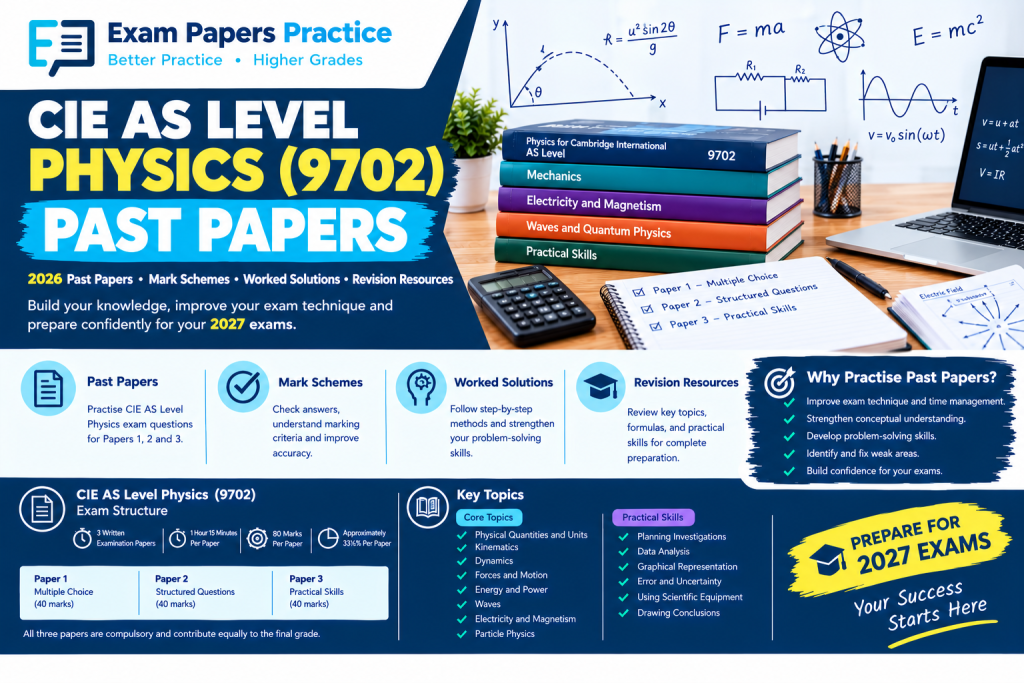
At Exam Papers Practice, students, teachers, tutors, and schools can explore revision resources designed to support preparation for Cambridge International AS Level Physics (9702). Use our collection of CIE AS Physics past papers, Cambridge 9702 mark schemes, and worked solutions, where available, to practise exam-style questions, review calculation methods, and track your revision progress. These resources can support independent study, classroom learning, tutoring, and AS Level Physics mock exam preparation. Reviewing mark schemes alongside your answers helps you understand the expected scientific terminology, present calculations clearly, use appropriate units, and identify topics that need further revision. Explore our Cambridge AS Level Physics revision resources to practise Paper 1 multiple-choice questions, Paper 2 structured questions, and Paper 3 advanced practical skills, according to the syllabus and examination route you are taking. Build confidence through targeted practice, strengthen your understanding of key physics principles, and prepare for your CIE AS Level Physics 9702 assessments in 2027.
Please be guided that we provide 1 free resource for you to have a grasp of what you can expect to get when you will subscribe to us to revise by topic and exam board with mark scheme
May / June 2026 CIE AS Level Physics (9702) Past Papers
CIE A & AS Level Physics (9702)
Feb / March 2026 CIE AS Level Physics (9702) Worked Solutions
Paper 1 Multiple Choice 9702/12
Paper 2 AS Level Structured Questions 9702/22
Paper 2 AS Level Structured Questions 9702/22
Feb / March 2026 CIE AS Level Physics (9702) Past Papers
Paper 3 Advanced Practical Skills 1 9702/33
Oct / Nov 2025 CIE AS Level Physics (9702) Past Papers
May / June 2025 CIE AS Level Physics (9702) Past Papers
Feb / March 2025 CIE AS Level Physics (9702) Past Papers
Oct / Nov 2024 CIE AS Level Physics (9702) Past Papers
May / June 2024 CIE AS Level Physics (9702) Past Papers
Feb / March 2024 CIE AS Level Physics (9702) Past Papers
CIE AS Level Physics (9702) 2019 Past Papers
2022 Specimen Papers
2016 Specimen Papers
CIE AS Level Physics (9702) Past Papers, Mark Schemes & Revision Guide 2027
Prepare for your CIE AS Level Physics (9702) 2026 past papers with focused revision, exam practice and mark scheme guidance at Exam Papers Practice. Whether you are preparing for 2027 Cambridge International AS Level Physics mock exams or final examinations, practising past papers can help you improve calculation accuracy, strengthen your understanding of core physics concepts and build confidence with exam-style questions. Revise key topics such as physical quantities and units, kinematics, dynamics, forces, work, energy and power, deformation of solids, waves, superposition, electricity, D.C. circuits and particle physics. Combine Cambridge AS Level Physics 9702 past papers with mark schemes, worked solutions and timed practice to identify weaknesses, understand how marks are awarded and improve your exam technique.
CIE AS Level Physics (9702) Exam Overview
Cambridge International AS Level Physics (9702) assesses the first 11 topic areas of the Cambridge International AS & A Level Physics syllabus. Students following the AS Level-only route take three examination papers: Paper 1 Multiple Choice, Paper 2 AS Level Structured Questions and Paper 3 Advanced Practical Skills. The papers test scientific knowledge, calculation skills, written explanations and practical investigation skills.
| Exam paper | Main content | Duration | Marks | AS Level weighting |
|---|---|---|---|---|
| Paper 1 | Multiple Choice | 1 hour 15 minutes | 40 | 31% |
| Paper 2 | AS Level Structured Questions | 1 hour 15 minutes | 60 | 46% |
| Paper 3 | Advanced Practical Skills | 2 hours | 40 | 23% |
| Total | AS Level qualification | — | 140 raw marks across papers | 100% |
The percentages show each paper’s contribution to the AS Level grade. The papers have different weightings, so their raw marks should not be treated as equally weighted when estimating the final result.
CIE AS Level Physics Paper 1: Multiple Choice
Paper 1: 1 hour 15 minutes, 40 marks
Paper 1 contains 40 multiple-choice questions based on the AS Level Physics syllabus. It tests your understanding of physical principles, definitions, equations, units, graphs and applications of physics.
Key revision areas include:
Physical quantities and units: SI units, prefixes, derived units and uncertainties.
Kinematics: Displacement, velocity, acceleration and motion graphs.
Dynamics: Forces, Newton’s laws, momentum and acceleration.
Forces, density and pressure: Moments, equilibrium, density and pressure.
Work, energy and power: Work done, energy transfers and power calculations.
Deformation of solids: Hooke’s law, force-extension graphs and elastic energy.
Waves and superposition: Wave properties, interference, diffraction and stationary waves.
Electricity and D.C. circuits: Current, potential difference, resistance and circuit calculations.
Particle physics: Fundamental particles and particle interactions.
Practise CIE AS Level Physics Paper 1 past papers to develop speed and accuracy. After each attempt, check the mark scheme and review why the correct option is right and why your selected option, if incorrect, does not fit the physics.
CIE AS Level Physics Paper 2: Structured Questions
Paper 2: 1 hour 15 minutes, 60 marks
Paper 2 assesses AS Level Physics through structured written questions. It tests your ability to apply equations, show calculations, explain physical principles, interpret graphs and use appropriate scientific terminology.
Important skills include:
Selecting and rearranging equations correctly.
Substituting values using consistent SI units.
Showing calculation steps clearly.
Interpreting graphs and experimental data.
Explaining physical processes using precise scientific language.
Applying concepts to unfamiliar situations.
Giving answers with appropriate units and significant figures.
Use CIE AS Physics Paper 2 past papers and mark schemes to practise complete written solutions. Avoid jumping straight to a numerical answer; show the method and make your reasoning clear.
CIE AS Level Physics Paper 3: Advanced Practical Skills
Paper 3: 2 hours, 40 marks
Paper 3 is a laboratory-based practical examination that assesses experimental skills. Candidates carry out practical tasks, record measurements, analyse results and evaluate experimental methods. The assessment focuses on practical competence rather than simply recalling theory.
Key practical skills include:
Taking accurate measurements and recording observations.
Constructing tables with suitable headings and units.
Plotting graphs using appropriate scales.
Drawing best-fit lines.
Calculating gradients and determining physical quantities from graphs.
Identifying errors and uncertainties.
Evaluating experimental procedures.
Suggesting specific improvements to measurement methods.
Drawing conclusions supported by data.
Practise CIE AS Level Physics Paper 3 practical past papers and, where possible, carry out experiments in the laboratory. Give particular attention to units, significant figures, graph scales, repeat measurements and the quality of your conclusions.
Complete CIE AS Level Physics (9702) Specification Summary
The AS Level section of the Cambridge International Physics 9702 syllabus contains 11 main topic areas. Use this summary to plan revision and identify areas that need more practice.
| Specification topic | Key areas to revise |
|---|---|
| 1. Physical quantities and units | SI units, derived units, prefixes, dimensions, errors and uncertainties |
| 2. Kinematics | Displacement, velocity, acceleration and motion graphs |
| 3. Dynamics | Forces, Newton’s laws, momentum and motion |
| 4. Forces, density and pressure | Moments, equilibrium, density and pressure |
| 5. Work, energy and power | Work done, energy transfers, efficiency and power |
| 6. Deformation of solids | Hooke’s law, force-extension graphs and elastic potential energy |
| 7. Waves | Wave properties, wavelength, frequency, period and wave speed |
| 8. Superposition | Interference, stationary waves and diffraction |
| 9. Electricity | Current, charge, potential difference, resistance and electromotive force |
| 10. D.C. circuits | Series and parallel circuits, internal resistance and potential dividers |
| 11. Particle physics | Fundamental particles, quarks, leptons and particle interactions |
Important: This page focuses on the AS Level content for Physics 9702. If you are studying the full A Level qualification, you will also need to revise the additional A Level topics. Check the official Cambridge International Physics 9702 syllabus for the examination year and route that apply to you.
Detailed Topic Breakdown for CIE AS Level Physics
1. Physical Quantities and Units
Physical quantities and units form the foundation of physics calculations. Understanding measurements, units and uncertainty is essential throughout the syllabus.
Understand the difference between a physical quantity’s numerical value and its unit.
Recall the SI base quantities and units required by the syllabus.
Express derived units in terms of SI base units.
Convert between prefixes and units.
Use dimensional consistency to check equations.
Understand systematic errors, random errors and zero errors.
Use appropriate significant figures and uncertainty conventions.
Practise converting units before substituting into equations. Check powers of ten carefully, especially when using prefixes such as milli, micro, kilo and mega.
2. Kinematics
Kinematics describes the motion of objects and the relationships between displacement, velocity and acceleration.
Distinguish distance from displacement.
Distinguish speed from velocity.
Calculate acceleration from changes in velocity.
Interpret displacement-time and velocity-time graphs.
Calculate displacement from the area under a velocity-time graph.
Determine velocity or acceleration from the appropriate graph gradient.
Apply the relevant equations of motion.
Learn what the gradient and area represent on different graphs. Many exam questions test whether you can interpret a graph physically rather than simply read a value from it.
3. Dynamics
Dynamics explains how forces affect motion.
Apply Newton’s laws of motion.
Identify resultant forces.
Use force diagrams to represent physical situations.
Calculate acceleration from resultant force and mass.
Understand momentum and impulse.
Apply conservation of momentum where required.
Explain how forces change an object’s velocity.
Draw a diagram when multiple forces act on an object. Use a consistent sign convention and check that your calculated acceleration or momentum has the correct direction.
4. Forces, Density and Pressure
This topic covers moments, equilibrium, density and pressure.
Understand moments of forces.
Apply the principle of moments.
Analyse equilibrium in physical systems.
Calculate density from mass and volume.
Relate pressure to force and area.
Apply the relevant relationships to fluids and other specified situations.
For moments questions, identify the pivot and the perpendicular distance from the pivot to the force’s line of action. For pressure calculations, use the correct area units.
5. Work, Energy and Power
Work, energy and power describe how energy is transferred and how quickly work is done.
Calculate work done by a force.
Understand kinetic energy and gravitational potential energy.
Apply conservation of energy.
Calculate power.
Understand efficiency and energy losses.
Use appropriate units in calculations.
Identify the energy changes in the system before choosing an equation. In explanation questions, describe where energy is transferred and whether it is useful or dissipated.
6. Deformation of Solids
Deformation describes how a material changes shape when forces act on it.
Understand extension and compression.
Apply Hooke’s law within its appropriate limits.
Interpret force-extension graphs.
Identify the limit of proportionality.
Understand elastic behaviour.
Calculate elastic potential energy where required.
Learn how the gradient and area under a force-extension graph relate to physical properties. State the relevant relationship and show your working in calculation questions.
7. Waves
Waves transfer energy and information without an overall transfer of matter.
Distinguish transverse and longitudinal waves.
Define amplitude, wavelength, frequency and period.
Apply the wave equation.
Understand phase difference.
Interpret wave diagrams and graphs.
Understand electromagnetic waves and their relevant properties.
Practise using the wave equation with consistent units. When comparing waves, explain how changes in frequency or wavelength relate to wave speed.
8. Superposition
Superposition describes how waves combine and produce interference effects.
Explain the principle of superposition.
Understand constructive and destructive interference.
Explain the formation of stationary waves.
Identify nodes and antinodes.
Understand diffraction and its significance.
Interpret wave experiments and relevant diagrams.
Use diagrams to explain interference and stationary waves. Include the relationship between path difference and phase difference when the question requires it.
9. Electricity
Electricity introduces charge flow, potential difference and resistance.
Define electric current and potential difference.
Apply relationships between charge, current and time.
Understand resistance and Ohm’s law where applicable.
Interpret current-voltage characteristics.
Understand electromotive force.
Distinguish electromotive force from potential difference.
Remember that current measures the rate of flow of charge, while potential difference describes energy transferred per unit charge. Use these definitions to support written explanations.
10. D.C. Circuits
Direct-current circuit questions require you to apply electrical relationships to circuit components.
Calculate resistance in series and parallel arrangements.
Apply the relevant circuit laws.
Understand electromotive force and internal resistance.
Calculate terminal potential difference.
Use potential dividers.
Interpret circuit diagrams and measurements.
Apply equations to multi-component circuits.
Check the arrangement of components before choosing a formula. Draw or label the circuit clearly if you need to track current and potential difference.
11. Particle Physics
Particle physics explores the fundamental particles that make up matter and the interactions between them.
Understand the distinction between hadrons and leptons.
Identify baryons and mesons.
Understand quarks and antiquarks.
Recall relevant particle properties.
Interpret particle symbols and simple interaction diagrams.
Apply the conservation rules required by the syllabus.
Practise particle classification and interaction questions. Check that the relevant conservation laws are satisfied when interpreting or completing particle equations.
CIE AS Level Physics Assessment Objectives
Understanding the assessment objectives helps you prepare for the different skills tested in Cambridge Physics 9702.
AO1 – Knowledge and understanding: Recall and demonstrate understanding of physical facts, laws, definitions, concepts, theories, scientific terminology and conventions.
AO2 – Handling, applying and evaluating information: Apply physics knowledge to problems, interpret information, analyse data and evaluate evidence.
AO3 – Experimental skills and investigations: Plan experiments, collect and analyse data, evaluate methods and draw evidence-based conclusions.
Paper 1 and Paper 2 focus on knowledge, application and written problem-solving. Paper 3 assesses practical skills. Check the official syllabus for the exact assessment-objective requirements and weightings for your examination year.
Read the official Cambridge Physics 9702 syllabus for full assessment details.
Common Mistakes in CIE AS Level Physics Exams
1. Using the wrong equation
The mistake: Selecting a formula based on familiar keywords without checking the quantities involved.
The solution: Identify the known quantities and the required answer first. Write the appropriate equation, rearrange it and substitute values with consistent units.
2. Making unit conversion errors
The mistake: Using incorrect prefixes or mixing units during calculations.
The solution: Convert quantities into suitable SI units before substituting. Check powers of ten and include the correct unit in the final answer.
3. Giving vague explanations
The mistake: Writing a general statement without explaining the physical principle.
The solution: Use correct scientific terminology and explain the relationship between cause and effect. Make each step of your explanation relevant to the question.
4. Misinterpreting graphs
The mistake: Reading the wrong scale or confusing a graph’s gradient with its area.
The solution: Read the axis labels and units carefully. Practise calculating gradients and areas and explaining what they represent physically.
5. Ignoring practical skills
The mistake: Focusing only on theory and leaving graph plotting, uncertainty and experimental evaluation until the end.
The solution: Practise Paper 3 skills regularly, including recording measurements, plotting graphs, drawing best-fit lines, calculating gradients and evaluating methods.
6. Showing insufficient working
The mistake: Giving only a final numerical answer for a multi-step calculation.
The solution: Write the equation, show substitution, include important intermediate steps and state the final answer with an appropriate unit.
7. Poor time management
The mistake: Spending too long on one question and rushing the remaining paper.
The solution: Complete timed practice papers. If you become stuck, move on when appropriate and return to the question if time allows.
How to Structure Strong Physics Answers
Use a consistent approach when answering CIE AS Level Physics questions.
Read the command word: Identify whether you need to state, describe, explain, calculate or determine something.
Identify the physics principle: Select the relevant law, equation or concept.
Write the equation: For numerical questions, begin with the appropriate relationship.
Substitute values carefully: Use consistent units and show your working.
Explain clearly: For written questions, use accurate terminology and link the relevant physical causes and effects.
Check the answer: Review units, significant figures, signs and whether the result is physically reasonable.
For practical questions, include appropriate measurements, units, graph analysis, uncertainties and evidence-based conclusions.
How to Revise Effectively for CIE AS Level Physics (9702)
Phase 1: Learn the AS Level specification
Review all 11 AS Level topic areas. Make a list of definitions, equations and concepts you need to learn, and identify the topics where you make the most mistakes.
Phase 2: Practise topic-based questions
Start with individual topics such as kinematics, dynamics, electricity and waves. Work through examples, then answer similar questions independently to check your understanding.
Phase 3: Develop practical skills
Practise measurement, data recording, graphs, gradients, uncertainties and experimental evaluation. Where possible, supplement past-paper practice with real laboratory experiments.
Phase 4: Complete timed past papers
Attempt Papers 1, 2 and 3 under realistic conditions. Allow 1 hour 15 minutes for Paper 1, 1 hour 15 minutes for Paper 2 and 2 hours for Paper 3.
Phase 5: Review mark schemes
Compare your answers with the relevant mark schemes. Identify missing steps, incorrect units, weak explanations and practical skills that need improvement.
Phase 6: Retest your weak topics
Keep an error log and revisit the questions you found difficult. Repeat similar questions without looking at the solution to check whether you can apply the correct method independently.
When Should You Start Using CIE AS Level Physics Past Papers?
Early revision: Learn core definitions, equations and concepts across all AS Level topics.
Mid-stage preparation: Complete topic-based questions and practise multi-step calculations.
Practical preparation: Develop graph plotting, measurement, uncertainty and evaluation skills for Paper 3.
Final preparation: Complete timed papers and review mark schemes carefully.
Before 2027 mock exams: Check that your papers and revision resources match the syllabus and examination route you are taking.
For students preparing for 2027 Cambridge AS Level Physics exams, consistent practice and a structured revision plan can help make preparation more effective.
Frequently Asked Questions: CIE AS Level Physics (9702)
Where can I find CIE AS Level Physics 9702 past papers?
Visit Exam Papers Practice to explore available AS Level Physics revision resources. You can also use the official Cambridge Physics 9702 page for syllabus information and links to official assessment resources. Past papers and mark schemes are available subject to what has been released for each examination series.
How many papers are there in CIE AS Level Physics 9702?
The AS Level-only route uses three examination papers: Paper 1 Multiple Choice, Paper 2 AS Level Structured Questions and Paper 3 Advanced Practical Skills.
What topics are covered in AS Level Physics 9702?
The AS Level syllabus covers physical quantities and units, kinematics, dynamics, forces, density and pressure, work, energy and power, deformation of solids, waves, superposition, electricity, D.C. circuits and particle physics.
What is the difference between AS Level Physics and A Level Physics 9702?
AS Level covers topics 1–11 and uses Papers 1, 2 and 3. Full A Level Physics includes the AS content plus topics 12–25 and requires Papers 4 and 5 as well. Students intending to complete the full A Level should plan revision for the additional topics and examinations.
Are 2026 AS Physics past papers useful for 2027 exams?
Yes, if they match the syllabus applicable to your examination. Past papers help you practise question styles, identify weak topics, improve timing and understand how marks are awarded. Always check the syllabus year and the relevance of each paper before using it.
How can I improve my CIE AS Level Physics grade?
Revise the syllabus topic by topic, practise past papers regularly, show your calculations clearly and review mark schemes after each attempt. Learn definitions and equations, work on written explanations and make time for practical skills.
Is Paper 3 important in AS Level Physics?
Yes. Paper 3 contributes 23% of the AS Level grade and assesses advanced practical skills. Practise data recording, graph plotting, uncertainty, experimental evaluation and evidence-based conclusions.
Where can teachers and schools find AS Level Physics resources?
Teachers and schools can consult Cambridge’s official syllabus and assessment resources for lesson planning, mock exams and feedback. Exam Papers Practice can complement classroom learning with available revision materials and exam-style practice.
Prepare for Your 2027 CIE AS Level Physics Exams with Exam Papers Practice
Achieving your target grade in CIE AS Level Physics (9702) requires a solid understanding of physics concepts, accurate calculations, effective exam technique and regular practical-skills practice. Working through past papers, checking mark schemes and correcting mistakes can help you identify weak areas and build confidence with unfamiliar questions.
At Exam Papers Practice, our revision resources support students, teachers, tutors and schools with focused exam preparation. Explore available CIE AS Level Physics past papers, Cambridge 9702 mark schemes and revision resources to organise your study, practise exam-style questions and prepare for all three AS Level papers.
Start practising today and take the next step towards stronger Cambridge AS Level Physics exam performance.
Are You Having Trouble with Your Studies? Get the Help You Need Today
If you’re struggling with your studies and looking for extra support, why not consider hiring a tutor or enrolling in summer school or Easter revision services? Whether you’re aiming to boost your grades or better understand complex topics, targeted revision can make a big difference. Accessing the right resources is crucial, and there are multiple options available to help you succeed.
Why Consider a Tutor for Your Studies?
A personal tutor can provide tailored support based on your individual learning needs. Tutors offer one-on-one sessions that focus on the areas where you need the most improvement. Whether it’s mathematics, science, or language arts, a tutor can provide targeted strategies and techniques to ensure that you understand key concepts and are prepared for upcoming exams.Summer School and Easter Revision Services: A Great Opportunity
Summer and Easter revision services are an excellent way to prepare for exams while still having time to relax. These sessions are structured to help you revisit your syllabus, revise key topics, and practice with exam papers. These services offer intensive study periods, which can be highly beneficial for students aiming to refresh their knowledge and boost confidence.Accessing the Board Syllabus for Efficient Studying
Accessing your exam board’s syllabus is one of the most effective ways to stay on track during your revision. The syllabus provides a clear outline of the topics you need to cover and allows you to prioritize areas that require more attention. The comprehensive CIE AS Level Physics (9702) syllabus ensures that you are following the right path and studying the correct resource material.Where to Find the Best Educational Services
For further support, you can check out services offered by our Sister Companies Lite Regal International College and Lite Regal Education, both of which provide expert tutors and revision resources. Whether you need a tutor for personalized lessons or are looking to join a revision group, these services have a wide range of options to fit your study needs.Reaching an A* in CIE A Level Physics (9702) syllabus is completely achievable—when you prepare the right way. With Exam Papers Practice, you’re not just reviewing facts—you’re training yourself to think like a top student.
Start by choosing one topic today. Try a few questions. Mark them. Reflect. Repeat.
Step by step, topic by topic, you’ll build confidence and sharpen your skills—and when exam day comes, you’ll be ready.
