
IGCSE Oxford AQA Computer Science (9210) Revision Notes
Prepare for your IGCSE OxfordAQA International Computer Science (9210) examinations with comprehensive revision notes designed around the key topics, concepts and subject content in the OxfordAQA specification. These resources provide a structured way to review computer science theory, strengthen your understanding of computational concepts and develop your knowledge of the principles behind computer systems, programming, data representation, algorithms and computational thinking. By revisiting important topics and learning key definitions, you can build a strong foundation in computer science and prepare more effectively for examination questions.
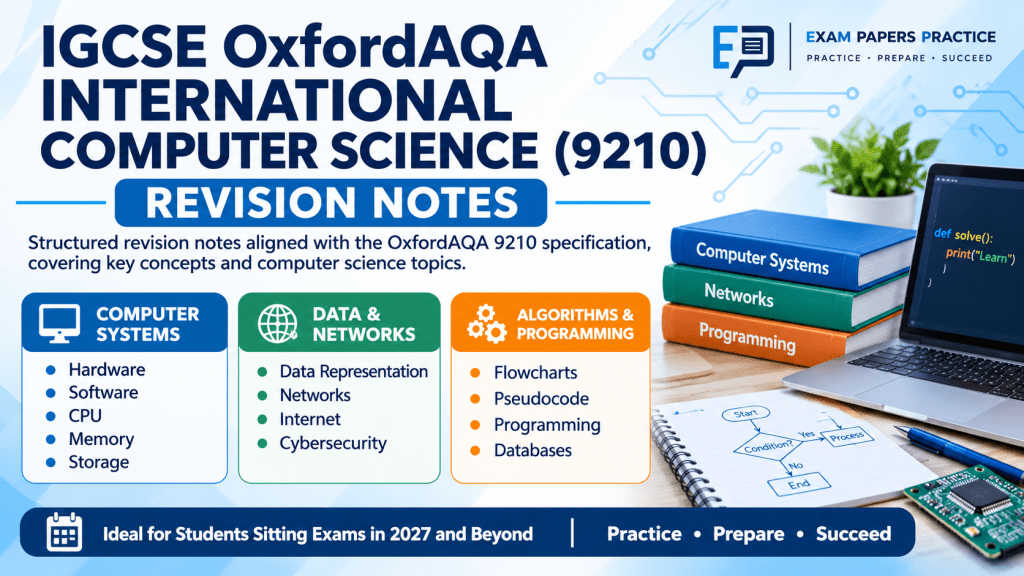
Our IGCSE OxfordAQA Computer Science (9210) Revision Notes are particularly useful for students who want to consolidate classroom learning, revisit challenging concepts and organise their revision around the structure of the qualification. Whether you are studying computer hardware, software, networks, data representation, cybersecurity, programming, algorithms, databases or the wider applications of computer science, these revision notes can help you understand complex topics, remember essential terminology and develop logical problem-solving skills. Use these resources to revise systematically, strengthen your theoretical knowledge, improve your understanding of programming concepts and build confidence before your IGCSE Computer Science examinations.
To give you a glimpse of what you’ll get when you subscribe (revision organized by topic and exam board), we’re providing 1 free, up-to-date exam resource for reference.
Topic Driven Revision Resources

IGCSE OxfordAQA Computer Science E-Book (Suitable for Students & Teachers)

Ideal for Students Sitting Exams in 2027 and Beyond
These revision notes are designed for students preparing for their OxfordAQA International GCSE Computer Science (9210) examinations and provide focused revision support across the major areas of the Computer Science specification. They can be used throughout the course to reinforce classroom learning, revisit challenging concepts and prepare for examination questions covering Algorithms, Programming, Data Representation, Computer Systems, Computer Networks, Cyber Security, Relational Databases and Web Page Design. Whether you are revising theoretical computer science concepts or developing your programming and computational thinking skills, these resources provide a structured way to review important topics and build a stronger understanding of the subject.
OxfordAQA International GCSE Computer Science is designed to develop both theoretical knowledge and practical programming skills. The qualification includes two examination papers: Paper 1 – Programming and Paper 2 – Concepts and Principles of Computer Science. Paper 1 focuses on writing, testing and improving computer programs using a pre-released skeleton program, while Paper 2 assesses understanding of the key concepts and principles of Computer Science. By following the specification structure, students can use these revision notes to review the appropriate content, strengthen their problem-solving ability and prepare systematically for their 2027 examinations and beyond.
Aligned with the OxfordAQA Computer Science 9210 Specification
Our revision resources follow the main subject areas identified in the OxfordAQA International GCSE Computer Science 9210 specification. OxfordAQA organises the course around eight core topics, covering computational thinking, programming, computer hardware and software, data representation, networking, cybersecurity, database systems and web technologies. These topics help students understand how computers process information, how programs are developed, how data is stored and communicated, and how computer systems are used in real-world applications.
Algorithms
The Algorithms topic develops students’ understanding of computational problem-solving and the methods used to design efficient solutions to problems. Students learn to break problems into manageable steps, represent algorithms using flowcharts and pseudocode, understand logical operations, trace algorithms and analyse how different approaches solve a given task. Revising algorithms helps students develop computational thinking, improve problem-solving techniques and prepare for questions involving logic, sequencing, selection, iteration and algorithm design.
Programming
Programming is a central component of the OxfordAQA International GCSE Computer Science qualification. Students develop the ability to write, understand, test, debug and modify programs while learning programming constructs, data types, variables, operators, selection, iteration, arrays, data structures, subroutines and file handling. The specification allows students to work with Python 3, C# or Visual Basic, helping them develop practical coding skills and understand how programming concepts can be used to create functional solutions. Revision notes can help students revisit syntax, programming logic, validation, testing and common programming errors.
Data Representation
The Data Representation topic focuses on how computers represent, process and store different types of information digitally. Students revise binary, denary and hexadecimal number systems, number conversions, binary arithmetic, units of data, character encoding, image representation, sound representation and data compression. Understanding these concepts is important for answering questions involving numerical conversions, storage calculations, digital media, ASCII, Unicode and the methods used to represent information within computer systems.
Computer Systems
Computer Systems revision covers the relationship between hardware and software, the main components of a computer and the processes involved in executing instructions. Students study the CPU, memory, storage devices, operating systems, system software, application software, computer architecture, logic gates and the fetch-execute cycle. Revising this topic helps students understand how computer components work together, how instructions are processed, the differences between memory and storage, and how hardware and software contribute to the performance and functionality of a computer system.
Computer Networks
The Computer Networks topic introduces the principles of communication between computer systems and the technologies that allow devices to exchange information. Students revise network types, network hardware, wired and wireless communication, network protocols, the internet, data transmission, network structures and the role of different networking technologies. These revision notes can help students understand how networks operate, how information travels between devices and how communication systems support internet services, connected computers and digital applications.
Cyber Security
Cyber Security develops students’ understanding of digital threats, vulnerabilities and the methods used to protect computer systems, networks and data. Students study security risks, malicious software, cyberattacks, social engineering, authentication, encryption, access controls and preventative security measures. Revisiting these concepts helps students recognise common threats, understand how attacks occur and explain the techniques organisations and individuals use to maintain data confidentiality, integrity and security.
Relational Databases and Structured Query Language (SQL)
The Relational Databases topic introduces how data is organised, stored, managed and retrieved using database systems. Students revise tables, records, fields, primary keys, foreign keys, relationships, data types, database design and the principles of relational databases. They also develop an understanding of Structured Query Language (SQL), including how database queries are used to retrieve, filter, sort, insert, update and manage information. These topics are important for understanding how databases support websites, applications, businesses and information systems.
Web Page Design
Web Page Design focuses on the principles and techniques used to create and structure web pages. Students revise HTML, web page structure, elements, tags, attributes, hyperlinks, images, formatting and the role of CSS in styling web content. Understanding web page design helps students explain how websites are developed, how content is organised and presented, and how HTML and CSS work together to create accessible, structured and visually organised web pages.
Revision Notes for Programming, Algorithms and Computer Science Theory
The structure of these resources makes it easier to revise the different components of the OxfordAQA International GCSE Computer Science qualification. Students can focus on theoretical Computer Science when developing their understanding of computer systems, data, networks and security, then work on programming and algorithms to strengthen their practical problem-solving and coding ability.
Rather than attempting to revise everything at once, students can work through individual topics, review important definitions, understand key processes and revisit programming examples step by step. Topic-based revision can also help identify areas where further study is needed, making it easier to organise revision sessions and concentrate on weaker concepts before examinations.
Use OxfordAQA Computer Science Revision Notes with Practice Questions and Past Papers
Revision notes are most effective when combined with question practice and programming exercises. Once you have reviewed a topic, use topic questions to test your understanding of computer science concepts, practise calculations involving data representation, trace algorithms, answer theoretical questions and apply programming techniques. You can then progress to past papers to practise the examination format, assess your knowledge and identify areas that require further revision.
For programming, practise reading existing code, identifying errors, tracing program execution, modifying code, writing subroutines and testing solutions against different inputs. For theoretical Computer Science, practise explaining processes, comparing technologies, describing security measures, interpreting data and applying technical terminology accurately.
Combining revision notes, programming practice, topic questions and past papers provides a more complete revision strategy: learn the concept, understand the process, practise the skill and apply your knowledge to exam-style questions.
Are You Having Trouble with Your Studies? Get the Help You Need Today
If you’re struggling with your studies and looking for extra support, why not consider hiring a tutor or enrolling in summer school or Easter revision services? Whether you’re aiming to boost your grades or better understand complex topics, targeted revision can make a big difference. Accessing the right resources is crucial, and there are multiple options available to help you succeed.
Why Consider a Tutor for Your Studies?
A personal tutor can provide tailored support based on your individual learning needs. Tutors offer one-on-one sessions that focus on the areas where you need the most improvement. Whether it’s mathematics, science, or language arts, a tutor can provide targeted strategies and techniques to ensure that you understand key concepts and are prepared for upcoming exams.
Summer School and Easter Revision Services: A Great Opportunity
Summer and Easter revision services are an excellent way to prepare for exams while still having time to relax. These sessions are structured to help you revisit your syllabus, revise key topics, and practice with exam papers. These services offer intensive study periods, which can be highly beneficial for students aiming to refresh their knowledge and boost confidence.
Accessing the Board Syllabus for Efficient Studying
Accessing your exam board’s syllabus is one of the most effective ways to stay on track during your revision. The syllabus provides a clear outline of the topics you need to cover and allows you to prioritize areas that require more attention.
The comprehensive Oxford AQA Computer Science (9210) Specification ensures that you are following the right path and studying the correct resource material.
Where to Find the Best Educational Services
For further support, you can check out services offered by our Sister Companies Lite Regal International College and Lite Regal Education, both of which provide expert tutors and revision resources. Whether you need a tutor for personalized lessons or are looking to join a revision group, these services have a wide range of options to fit your study needs.
Success in IB Psychology HL isn’t about studying harder—it’s about studying smarter. With Exam Papers Practice, you don’t have to sift through endless textbooks or outdated notes. Everything you need is structured, simplified, and exam-ready.
Start early, revise regularly, use our notes actively, and practice past papers with confidence.