AQA A-Level Physics (7408) Past Papers for 2027+ Exams
Perfect for AQA A-Level Physics (7408) exam review in line with the latest syllabus.
Prepare for your AQA A-Level Physics (7408) exams with exam-specific past papers designed to help you practise challenging physics questions, develop mathematical problem-solving skills and improve your examination technique. AQA A-Level Physics covers a broad range of topics, including particles and radiation, waves, mechanics, electricity, thermal physics, fields and nuclear physics, together with an optional topic.
At Exam Papers Practice, students can combine AQA A-Level Physics 7408 past papers with revision notes and topic questions to create a structured and effective revision programme. Past papers allow you to apply what you have learned to realistic examination questions while identifying topics and skills that need further practice.
Please be guided that we provide 1 free resource for you to have a grasp of what you can expect to get when you will subscribe to us to revise by topic and exam board with mark scheme
May/June 2026 AQA A Level Physics (7408) Past Papers
May/June 2025 AQA A Level Physics (7408) Past Papers
May/June 2018 AQA A Level Physics (7408) Past Papers
May/June 2017 AQA A Level Physics (7408) Past Papers
2016 Specimen Papers
Ideal for Students Sitting Exams in 2027 and Beyond
These AQA A-Level Physics 7408 past papers are ideal for students preparing for mock examinations and final A-level exams in 2027 and beyond. Regular practice can help you become more confident with calculations, practical questions, data analysis, multiple-choice questions and extended-response problems.
For the best revision approach, students should use past papers alongside revision notes and topic questions. Revision notes can help you consolidate difficult physics concepts, while topic questions allow you to focus on individual areas before testing your knowledge with a complete examination paper.
Based on our experience, students who consistently use past papers, revision notes and topic questions can significantly improve their examination preparation and performance. Some students have achieved improvements of two or even three grades when making effective use of our online resources as part of a consistent revision programme. Results will vary between students depending on their starting point, revision habits, understanding and overall exam preparation.
Latest AQA A-Level Physics 7408 Past Papers
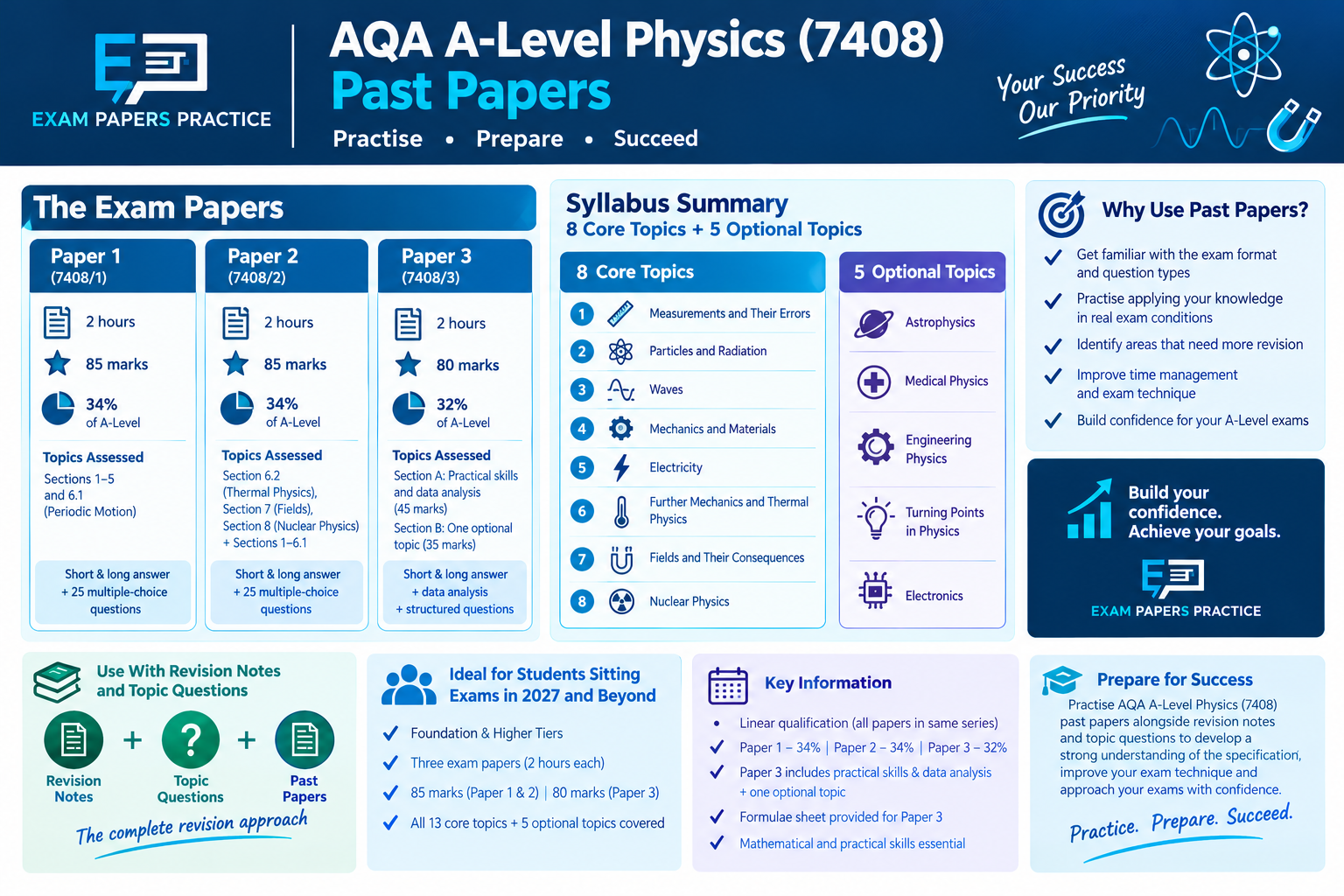
AQA A-Level Physics is assessed through three written examination papers at the end of the course. Students must complete all assessments in the same examination series because the qualification is linear.
Papers 1 and 2 each carry 85 marks and account for 34% of the A-level. Paper 3 carries 80 marks and accounts for the remaining 32%.
Working through a selection of AQA Physics 7408 past papers can help you become familiar with the different question formats and develop the ability to apply physics principles across multiple areas of the specification.
AQA A-Level Physics 7408 Exam Papers
Paper 1 – 7408/1
AQA Physics Paper 1 is a 2-hour examination worth 85 marks, contributing 34% of the A-level.
Paper 1 assesses Sections 1–5 and Section 6.1 (Periodic Motion). The paper contains a combination of short and long-answer questions worth 60 marks, together with 25 multiple-choice questions.
Students should practise both calculations and written explanations when preparing for Paper 1, particularly questions requiring the application of equations and physical principles to unfamiliar situations.
Paper 2 – 7408/2
Paper 2 is another 2-hour, 85-mark examination, contributing 34% of the A-level.
The paper assesses Section 6.2 Thermal Physics, Section 7 Fields and Their Consequences, and Section 8 Nuclear Physics, while also assuming knowledge from Sections 1–6.1.
This makes Paper 2 particularly important for students who need to connect concepts from different parts of the specification. Regular past paper practice can help you identify how AQA combines mathematical, theoretical and applied physics.
Paper 3 – 7408/3
Paper 3 is a 2-hour examination worth 80 marks, contributing 32% of the A-level.
The paper is divided into two sections. Section A is compulsory and assesses practical skills and data analysis for 45 marks. Section B is worth 35 marks and assesses one optional topic chosen from Astrophysics, Medical Physics, Engineering Physics, Turning Points in Physics or Electronics.
Practising Paper 3 is particularly useful because it allows you to develop your ability to analyse experimental data, evaluate methods and apply physics to practical situations.
AQA A-Level Physics 7408 Syllabus Summary
The AQA Physics 7408 specification consists of eight core content sections, followed by five optional topics.
1. Measurements and Their Errors
This section develops the measurement, uncertainty and data-handling skills needed throughout A-level Physics. Students learn about measurements, errors, uncertainties, significant figures and the use of appropriate scientific methods.
2. Particles and Radiation
Particles and Radiation covers subatomic particles, particle interactions, quantum phenomena and radiation. Students develop their understanding of fundamental particles and the evidence used to support models of matter.
3. Waves
The Waves section covers progressive and stationary waves, interference, diffraction, refraction and polarisation. Students also develop mathematical techniques for analysing wave behaviour.
4. Mechanics and Materials
Mechanics and Materials covers forces, motion, momentum, energy, materials and mechanical properties. Students apply mathematical methods to physical situations involving motion, forces and deformation.
5. Electricity
The Electricity section develops understanding of current, potential difference, resistance, circuits, electrical energy and related mathematical relationships. Students also develop practical skills through circuit investigations and data analysis.
6. Further Mechanics and Thermal Physics
This A-level-only section extends mechanics and introduces thermal physics. Topics include circular motion, simple harmonic motion, thermal properties and ideal gases.
7. Fields and Their Consequences
Fields covers gravitational, electric and magnetic fields and their associated forces and potential. Students learn how field concepts can be applied to a range of physical systems.
8. Nuclear Physics
Nuclear Physics examines nuclear structure, radioactive decay, nuclear reactions, mass-energy relationships and applications of nuclear physics.
AQA A-Level Physics Optional Topics
Paper 3 Section B requires students to study one optional topic. AQA provides five options within the specification.
Astrophysics
Astrophysics explores stars, astronomical observations, stellar evolution and the physical principles used to understand objects and processes in the Universe.
Medical Physics
Medical Physics examines applications of physics in medicine, including imaging and other technologies used for diagnosis and treatment.
Engineering Physics
Engineering Physics applies physical principles to engineering contexts and develops understanding of how physics can be used to solve practical problems.
Turning Points in Physics
Turning Points in Physics explores important developments that changed scientific understanding and the experiments and ideas behind them.
Electronics
Electronics covers electronic components, circuits and systems and develops understanding of how electronic devices can be designed and analysed.
Practical Skills in AQA A-Level Physics
Practical work is an important component of AQA A-Level Physics. At least 15% of the overall assessment assesses knowledge, skills and understanding relating to practical work. AQA also identifies practical and mathematical problem-solving as important parts of the qualification.
Students should therefore practise questions involving experimental design, measurements, uncertainties, graphs, data analysis, evaluation and drawing conclusions from evidence.
Past papers can be particularly useful for identifying how practical skills are assessed in written examinations.
Mathematical Skills in AQA A-Level Physics
A strong mathematical foundation is essential for A-level Physics. AQA states that 40% of the overall assessment contains mathematical skills equivalent to Level 2 or above.
When practising past papers, students should therefore pay close attention to calculations, rearranging equations, interpreting graphs, handling units, significant figures and applying mathematical relationships to unfamiliar physical situations.
Why Practice AQA A-Level Physics 7408 Past Papers?
Past papers allow you to apply your knowledge to realistic examination questions rather than simply reviewing theory. They can help you become familiar with AQA’s question styles and understand how physics knowledge, mathematical skills and practical understanding are assessed.
Regular practice can also improve your ability to manage your time during examinations. Completing papers under timed conditions helps you learn how long to spend on different questions and reduces the risk of leaving questions unfinished.
After completing each paper, review the questions you found difficult and use your revision notes and topic questions to target those weaknesses.
How to Use AQA A-Level Physics 7408 Past Papers Effectively
Start by reviewing your revision notes and making sure you understand the relevant physics concepts. Use topic questions to practise individual areas before attempting a complete examination paper.
When you are ready, complete a past paper under realistic timed conditions. Avoid looking at your notes while working through the paper so that you can accurately assess your current level of understanding.
Once you have finished, mark your answers carefully and identify where marks were lost. Pay particular attention to calculation errors, missing units, incorrect significant figures, weak explanations and questions involving data analysis or practical skills.
Return to the relevant revision notes and complete additional topic questions before attempting another past paper.
Using the cycle of revision notes → topic questions → past papers → review and improve can make your revision more targeted and effective.
Prepare for the 2027 AQA A-Level Physics Exams
For students sitting AQA A-Level Physics 7408 examinations in 2027, Paper 1 (7408/1) is scheduled for 21 May 2027, Paper 2 (7408/2) for 27 May 2027, and Paper 3 (7408/3) for 8 June 2027. Each examination is 2 hours long.
The non-exam assessment submission deadline for 7408/C in the June 2027 series is 15 May 2027, although schools and colleges may set their own internal deadlines.
AQA A-Level Physics Past Papers with Revision Notes and Topic Questions
Past papers work best as part of a wider revision strategy. Use revision notes to strengthen your understanding of difficult concepts, topic questions to practise specific areas of the specification, and past papers to test your knowledge under realistic examination conditions.
This approach is particularly useful for A-level Physics because the examinations require students to combine theoretical understanding, mathematical calculations, practical skills and data analysis.
Build Your AQA A-Level Physics Exam Confidence
A-level Physics can be challenging, particularly when questions require you to combine several concepts or apply familiar equations to unfamiliar situations. Consistent examination practice can help you become more comfortable with these challenges.
The more past papers you complete, the easier it becomes to recognise the underlying physics in unfamiliar questions. Reviewing your mistakes is equally important because it helps you understand exactly where your knowledge or exam technique needs improvement.
Prepare for AQA A-Level Physics 7408 with Exam Papers Practice
Exam Papers Practice provides exam-focused resources to support students preparing for AQA A-Level Physics (7408).
Use our past papers alongside revision notes and topic questions to strengthen your understanding of the specification, practise mathematical and practical skills, and develop the examination technique needed for A-level Physics.
Whether you are preparing for school or college mock examinations or your final A-level exams, consistent practice can help you approach your Physics 7408 examinations with greater confidence.
Practise. Prepare. Succeed.
Having trouble with your AQA A-Level Physics (7408) revision?
Boost your grades with expert physics practice and targeted learning resources today!
If you’re finding AQA Physics challenging and need extra guidance, consider getting support from a qualified tutor or enrolling in summer school or Easter revision programs. Whether you’re aiming to boost your grades or gain a deeper understanding of complex topics like Fields, Mechanics, or Astrophysics, consistent and focused revision can make all the difference. Accessing the right past papers and study materials is essential to your success — and there are multiple options available to help you prepare effectively.
Why Use AQA A-Level Physics (7408) Past Papers and Topic Questions?
Practicing with AQA A-Level Physics past papers and topic questions helps you understand how examiners structure queries and what they expect in top-band answers. These resources improve your problem-solving skills, exam technique, and time management — ensuring you perform confidently on the day of your exam.
Working through real exam-style papers allows you to identify weak areas early and strengthen your understanding of every core and optional topic in the AQA Physics syllabus.
Summer School and Easter Revision Support: Boost Your Physics Performance
Joining summer or Easter revision courses can be an excellent way to prepare effectively for your upcoming exams. These sessions are designed to help you review essential topics, practice with AQA Physics past papers, and get one-on-one help from experienced tutors. Intensive revision periods like these can help you refresh your understanding, build confidence, and improve your exam strategy before the final assessments.
Following the AQA A-Level Physics (7408) Syllabus
Understanding and following the AQA A-Level Physics (7408) specification is key to efficient exam preparation. The specification outlines every topic you need to cover, helping you plan your revision and focus on areas that require more attention. It ensures that every past paper and practice question you attempt is directly relevant to your exams, helping you stay organized and exam-ready.
Where to Find the Best Physics Support Services
For additional guidance, explore services from our sister organizations, Lite Regal International College and Lite Regal Education, both offering expert tutors and revision courses tailored for A-Level students. Whether you prefer personalized one-to-one tutoring or group revision classes, these services provide flexible options to help you reach your academic goals and achieve your desired grade in AQA A-Level Physics (7408).
Success in AQA A-Level Physics (7408) exams doesn’t come from last-minute cramming. It comes from consistent, focused practice — exactly what we provide here at Exam Papers Practice. By regularly working through our AQA A Level Physics past papers and mark schemes, you’ll strengthen your understanding of core topics, refine your exam technique, and build the confidence needed to achieve the results you deserve.
