
IGCSE Edexcel English Literature (4ET1) Past Papers for 2027+ Exams
Prepare for your IGCSE Edexcel English Literature (4ET1) exams with exam-specific past papers, revision notes and topic questions from Exam Papers Practice. Our online resources are designed to help students strengthen their literary analysis, develop essay-writing skills and build confidence when studying poetry, prose and drama.
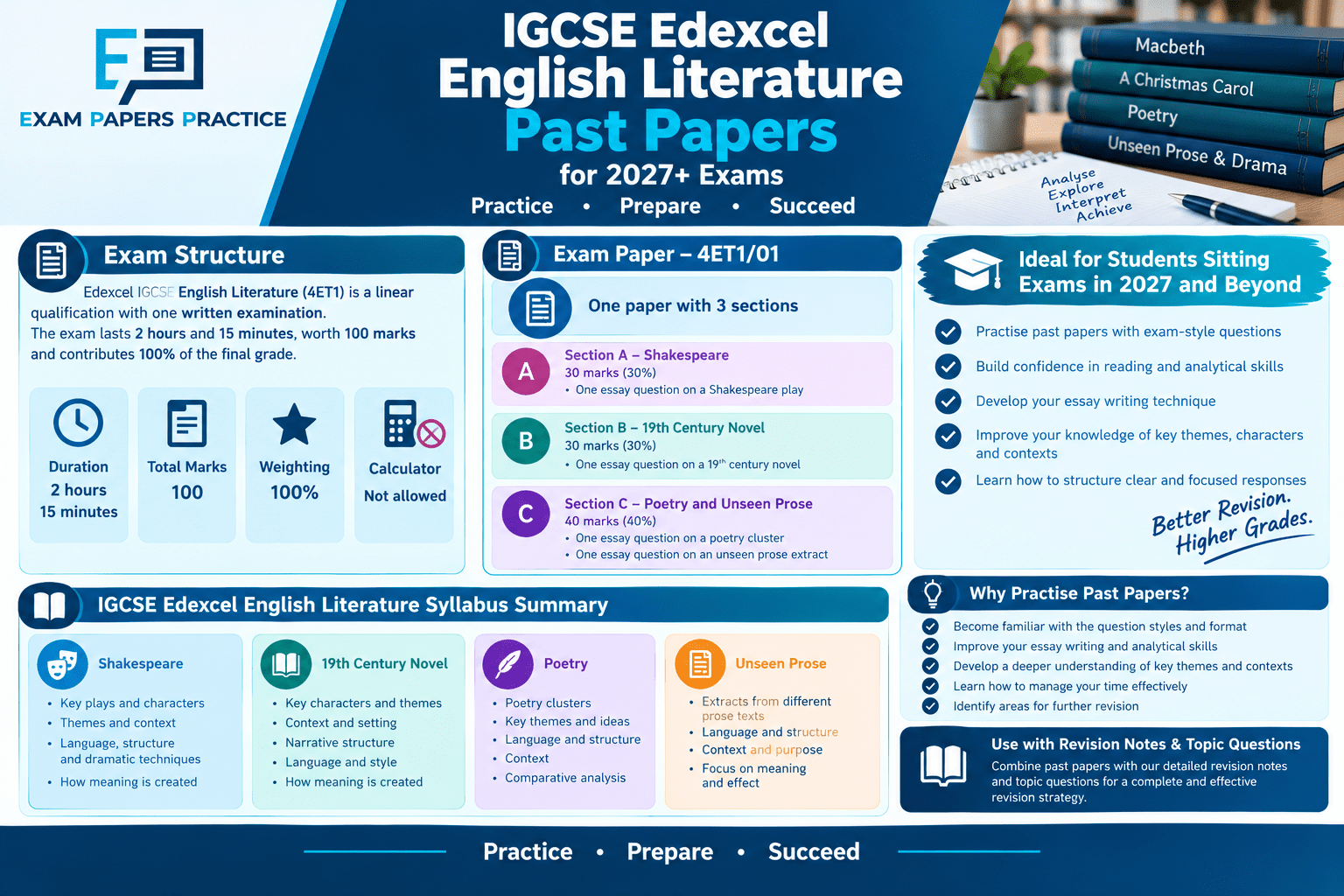
Ideal for students sitting exams in 2027 and beyond, these resources support structured revision through exam-style practice, topic-focused learning and repeated application of the skills required by the Pearson Edexcel International GCSE English Literature specification.
Please note we have provided the 1st PDF as a free download as an example to see what you will get if you subscribe to our platform Exam Papers Practice.
IGCSE Edexcel English Literature (4ET1) May/June 2026 Past Paper Resources
IGCSE Edexcel English Literature (4ET1) May/June 2025 Past Paper Resources
Paper 2 (Modular): Unit 2 - Modern Drama and Literary Heritage Texts (4WET1/02)
Paper 2 (Modular): Unit 2 - Modern Drama and Literary Heritage Texts (4WET1/02R)
IGCSE Edexcel English Literature (4ET1) November 2024 Past Paper Resources
Paper 2 - Modern Drama and Literary Heritage Texts (4ET1/02)
IGCSE Edexcel English Literature (4ET1) May/June 2024 Past Paper Resources
Paper 2 - Modern Drama and Literary Heritage Texts (4ET1/02)
Paper 2 - Modern Drama and Literary Heritage Texts (4ET1/02R)
IGCSE Edexcel English Literature Past Papers
Using IGCSE Edexcel English Literature past papers is an effective way to understand the examination format, practise essay questions, and improve the quality of literary analysis. Students need to demonstrate detailed knowledge of their studied texts, explain how writers use language and structure, explore themes and characters, and consider the effects of contextual influences where required.
Past papers also help students become familiar with different question styles and learn how to construct clear, well-supported arguments. By reviewing their answers and identifying areas for improvement, students can develop a more focused revision strategy.
At Exam Papers Practice, students can combine past papers with revision notes and topic questions to review important literary concepts, practice specific skills, and prepare for complete examination papers.
Edexcel IGCSE English Literature (4ET1) Exam Structure
Pearson Edexcel International GCSE English Literature (4ET1) is a linear qualification with a compulsory Component 1 and a choice between Component 2, an examination, or Component 3, coursework. Component 1 contributes 60% of the qualification, while the selected second component contributes the remaining 40%. Students do not complete both Components 2 and 3 for the same qualification route.
Component 1 – Poetry and Modern Prose
Paper code: 4ET1/01
Assessment: Written examination
Duration: 2 hours
Total marks: 90
Weighting: 60%
Assessment format: Closed book
Component 1 is compulsory for all students. It assesses their understanding of unseen poetry, anthology poetry, and modern prose through three sections.
Section A – Unseen Poetry
Total marks: 20
Students analyze an unseen poem and write an essay exploring its meaning and effects. This section assesses their ability to interpret a writer’s choices and explain how language, form, and structure contribute to meaning.
Effective preparation includes practicing close textual analysis, identifying poetic techniques, and explaining their effects using relevant evidence. Students should aim to develop interpretations rather than simply identify literary devices.
Section B – Anthology Poetry
Total marks: 30
Students answer a comparative essay question on two poems from the prescribed Pearson Edexcel English Anthology. They must explore similarities and differences in the poets’ ideas, themes, language, and techniques.
Revision should involve studying the poems in the relevant anthology, understanding their central themes, and developing comparisons supported by precise textual references. Students should also practice organizing comparative arguments into clear, connected paragraphs.
Section C – Modern Prose
Total marks: 40
Students respond to an essay question on their studied modern prose text. This section rewards detailed textual knowledge, a critical personal response, and, where relevant, an understanding of context.
Students should revise key characters, relationships, themes, narrative methods, and significant events. Preparing flexible evidence and practicing analytical paragraphs can help students respond effectively to a range of possible questions.
Component 2 – Modern Drama and Literary Heritage Texts
Paper code: 4ET1/02
Assessment: Written examination
Duration: 1 hour 30 minutes
Total marks: 60
Weighting: 40%
Assessment format: Open book
Component 2 is the examined alternative to Component 3. Students answer two essay questions: one on a prescribed modern drama text and one on a prescribed literary heritage text. Each section is worth 30 marks. Prescribed editions of the studied texts are permitted, but they must be completely unmarked.
Section A – Modern Drama
Students analyze their selected modern drama text, exploring characters, themes, dramatic methods, and the ways meaning is created. Strong responses explain how dialogue, stage directions, structure, and dramatic techniques contribute to the audience’s understanding.
Section B – Literary Heritage Texts
Students write an analytical essay on their prescribed literary heritage text. Preparation should include understanding the text’s historical and social context, studying important characters and themes, and explaining how language and structure communicate ideas.
Because this is an open-book examination, students should also become familiar with their permitted edition. They must follow Pearson’s rules regarding the prescribed edition and ensure that it is unmarked.
Component 3 – Modern Drama and Literary Heritage Texts Coursework
Paper code: 4ET1/03
Assessment: Non-examined assessment
Total marks: 60
Weighting: 40%
Component 3 is the coursework alternative to Component 2. It consists of two assignments, each worth 30 marks. Assignment A focuses on modern drama, while Assignment B focuses on a literary heritage text. The work is assessed internally and externally moderated by Pearson.
Students completing this route should follow their school’s instructions and Pearson’s requirements for setting, completing, and submitting coursework. Past papers remain particularly useful for Component 1, while revision notes and topic questions can support preparation for the literary texts studied for coursework.
IGCSE Edexcel English Literature (4ET1) Syllabus Summary
The syllabus develops students’ ability to read literary texts critically, interpret writers’ choices, and communicate informed personal responses. Students study poetry, modern prose, modern drama, and literary heritage texts according to their selected qualification route.
Unseen Poetry
Students learn to interpret unfamiliar poems, explore themes and meanings, and analyze how poets use language, form, and structure to create effects.
Anthology Poetry
Students study the prescribed poems in the Pearson Edexcel English Anthology. Key skills include comparing ideas, analyzing poetic techniques, and supporting interpretations with relevant evidence.
Modern Prose
Students develop detailed knowledge of a prescribed prose text, including its characters, themes, narrative structure, language, and relevant contextual influences.
Modern Drama
Students study a prescribed play and explore dramatic techniques, dialogue, stage directions, character development, relationships, and themes.
Literary Heritage Texts
Students analyze a prescribed literary heritage text, considering its language, structure, characters, themes, and relevant social or historical context.
Literary Analysis and Essay Writing
Across the qualification, students need to communicate clear interpretations, select appropriate evidence, explain writers’ methods, and construct logically organized analytical essays. Effective revision should therefore combine text knowledge with regular practice in developing and supporting arguments.
Important: The exact set texts depend on the specification and route selected by the school. Students should check their prescribed texts against the current Pearson specification and their teacher’s guidance.
Why Practice Edexcel English Literature Past Papers?
Past papers allow students to apply their knowledge to realistic examination questions and identify the literary skills they need to improve. They can also help students become more confident with essay planning, textual evidence, comparative analysis, and time management.
For English literature, knowing the plot alone is not enough. Students need to explain how writers create meaning and support their interpretations with relevant evidence. Regular practice helps students develop more analytical responses rather than relying on plot summaries or general comments about characters.
Reviewing completed answers is equally important. Students should identify where their arguments lack evidence, where analysis needs greater depth and where comparisons or contextual points could be more precise.
Use Past Papers with Revision Notes and Topic Questions
A structured revision programme works best when students combine different learning resources. Revision notes can help clarify themes, characters, literary techniques and contextual information. Topic questions allow students to practise individual skills, while past papers help them apply those skills to examination-style tasks.
Exam Papers Practice brings these revision methods together through its online educational resources. Students can review difficult concepts, focus on weaker areas and gradually build towards timed examination practice.
Full resources require a subscription, with one free downloadable preview available for students who want to explore the platform.
How to Use IGCSE Edexcel English Literature Past Papers Effectively
Start by reviewing the texts and literary techniques covered by your course. Make sure you understand the major themes, key characters, and important moments before attempting essay questions.
Next, practice individual questions. Plan a clear argument, select relevant quotations or textual references, and explain how the writer’s choices support your interpretation. For poetry comparison, focus on meaningful connections rather than discussing each poem separately without linking them.
As your confidence improves, complete past-paper sections under timed conditions. Review your answers afterwards and use revision notes or topic questions to address recurring weaknesses. Finally, practice completing Component 1 papers within the two-hour limit.
If you are taking Component 2, also practice organizing two essays within the 90-minute examination. If you are completing Component 3, follow your school’s coursework guidance and the relevant Pearson assessment requirements.
Ideal for Students Sitting Exams in 2027 and Beyond
Our IGCSE Edexcel English Literature past papers, revision notes and topic questions are designed to support students preparing for exams in 2027 and beyond.
Using past papers alongside extension revision notes and topic-based practice can provide a more structured approach to preparation. In our experience, students who consistently use a combination of online revision resources and exam-style practice have achieved significant improvements in their results, with some achieving grades two or three times better than before. Individual outcomes vary depending on starting point, effort, consistency, and other factors.
The key is to practise regularly, learn from mistakes and improve the quality of each response. Students should also confirm that their resources match their current specification and prescribed texts.
Struggling with Your IGCSE Edexcel English Literature Revision?
Preparing for the IGCSE Edexcel English Literature exam can feel challenging — but you don’t have to face it alone. One of the most effective ways to strengthen your understanding and boost exam performance is by practicing with past papers. With the right approach and resources, you can build confidence, refine analytical skills, and maximize your score potential.
Why Use IGCSE Edexcel English Literature (4ET1) Past Papers for Revision?
Past papers are a vital tool for mastering exam structure, timing, and question styles. They help you understand how questions are phrased, identify key topics, manage time effectively, and pinpoint areas needing extra practice. Past papers turn revision into active learning and prepare you for the challenges of the real exam.
Combine Past Papers with Expert Guidance
If certain topics feel difficult, working with a tutor or joining focused revision sessions can make a significant difference. One-on-one tutoring or small group classes provide step-by-step explanations for complex questions, personalized strategies tailored to your learning style, and exam-focused techniques to improve accuracy and speed. These sessions help transform confusion into clarity, making revision more efficient and effective.
How Past Papers Help You Master the IGCSE Edexcel English Literature (4ET1) Syllabus
The IGCSE Edexcel English Literature (4ET1) syllabus requires both conceptual understanding and practical skills. Using past papers helps you track progress, focus on weak areas, and become familiar with question types and marking schemes, ensuring your study time is focused on mastering exam-style problems.
Where to Find Reliable IGCSE Edexcel English Literature Past Papers and Revision Resources
At Exam Papers Practice, we offer a complete range of past papers, topic questions, and revision resources carefully designed by subject experts. You can also explore support from our sister institutions Lite Regal International College and Lite Regal Education – both renowned for delivering premium tutoring and revision programs.
Success in IGCSE Edexcel English Literature Exams doesn’t come from last-minute revision — it comes from consistent, smart practice. By solving past papers regularly, analyzing your mistakes, and improving your techniques, you’ll develop the skills, confidence, and precision needed to excel.