
GCSE Edexcel Physics (1PH0) Past Papers for 2027 Exams and Beyond
Prepare for your Pearson Edexcel GCSE Physics (1PH0) examinations with our comprehensive collection of past paper practice resources. Designed for students sitting their GCSE Physics exams in 2027 and beyond, these resources help you become familiar with the Pearson Edexcel assessment format, question styles, scientific terminology and the types of calculations and applications you may encounter in your examinations.
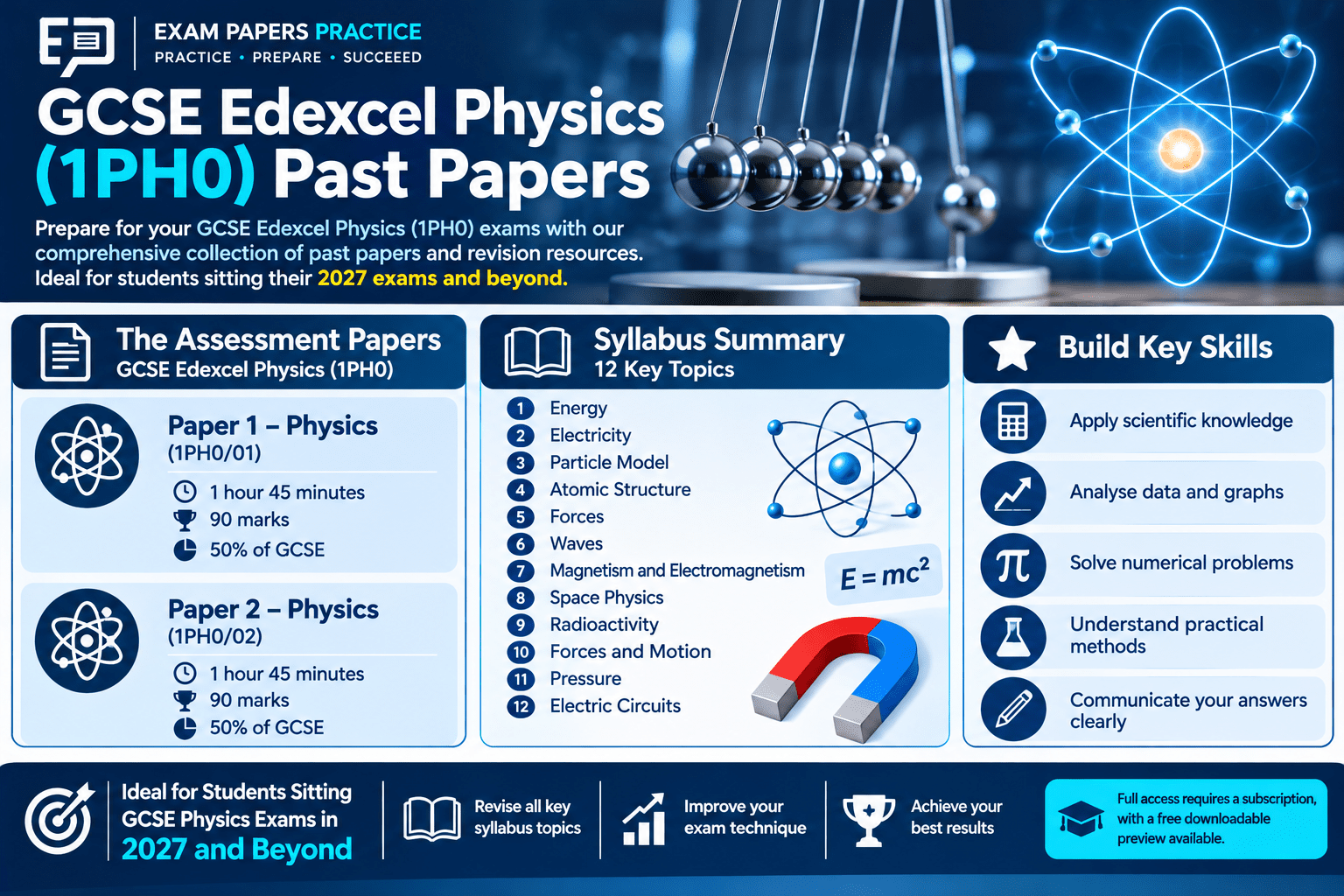
Practice questions covering the full Edexcel GCSE Physics specification, including motion and forces, energy, waves, electricity, radioactivity, particle models, and magnetism and electromagnetism. Regular practice with examination-style questions can help you apply your physics knowledge, improve your problem-solving skills and become more confident when working through calculations, practical-based questions and extended responses.
Whether you are working towards your Foundation or Higher tier examinations, Edexcel GCSE Physics past papers can help you identify areas that require further revision and develop a stronger understanding of how physics concepts are tested in real examination situations.
To give you a glimpse of what you’ll get when you subscribe (revision organized by topic and exam board, complete with mark schemes), we’re providing 1 free, up-to-date exam resource for reference.
GCSE Edexcel Physics (1PH0) Past Papers - May/June 2026
Foundation Tier
Higher Tier
GCSE Edexcel Physics (1PH0) Past Papers - May/June 2025
Foundation Tier
Higher Tier
GCSE Edexcel Physics (1PH0) Past Papers - May/June 2024
Foundation Tier
Higher Tier
Ideal for Students Sitting GCSE Physics Exams in 2027 and Beyond
Our GCSE Edexcel Physics 1PH0 past paper resources are ideal for students preparing for upcoming examinations. Working through papers from different examination series can help you understand how questions are structured, practice applying equations, and improve your ability to interpret graphs, diagrams, experimental data and scientific information.
Use past papers as part of a wider revision strategy alongside revision notes and topic questions. This allows you to revise individual areas of the specification before testing your knowledge under examination conditions.
GCSE Edexcel Physics (1PH0) Past Papers
Pearson Edexcel GCSE Physics (1PH0) is assessed through two externally examined written papers. Students are entered for either Foundation or Higher tier and must take the same tier for both papers.
Paper 1 – 1PH0/1F or 1PH0/1H
Paper 1 assesses knowledge and understanding across the Edexcel GCSE Physics specification. Students can be entered for either Foundation tier (1PH0/1F) or Higher tier (1PH0/1H).
Paper 2 – 1PH0/2F or 1PH0/2H
Paper 2 provides further assessment of the GCSE Physics specification and is also available at Foundation and Higher tier. Students must be entered for the same tier across both examination papers.
Both papers can require students to apply their knowledge to calculations, practical situations, scientific data, diagrams and unfamiliar contexts.
Edexcel GCSE Physics (1PH0) Syllabus Summary
The Pearson Edexcel GCSE Physics specification covers a broad range of physics concepts and their applications.
1. Key Concepts of Physics
Develop an understanding of fundamental physical quantities, units, measurements and the scientific principles used throughout the qualification.
2. Motion and Forces
Revise speed, velocity, acceleration, distance-time graphs, velocity-time graphs, forces, momentum and the relationships between force, mass and acceleration.
3. Conservation of Energy
Study energy stores and transfers, work done, power, efficiency and the conservation of energy. Practise applying equations to different energy-related situations.
4. Waves
Understand the properties and behaviour of waves, including transverse and longitudinal waves, reflection, refraction and the electromagnetic spectrum.
5. Light and the Electromagnetic Spectrum
Revise visible light, infrared, ultraviolet and other parts of the electromagnetic spectrum, together with their properties, uses and potential hazards.
6. Radioactivity
Study atomic structure, isotopes, radioactive decay, alpha, beta and gamma radiation, half-life and the uses and risks associated with ionising radiation.
7. Astronomy and Space Physics
Explore the Solar System, stars, galaxies and the wider Universe while developing an understanding of physical processes occurring in space.
8. Energy – Forces Doing Work
Understand how forces transfer energy through mechanical work and apply relevant equations to practical and theoretical problems.
9. Forces and Their Effects
Study moments, pressure, forces, elasticity and the effects of forces on objects and materials.
10. Electricity and Circuits
Revise current, potential difference, resistance, series and parallel circuits, electrical power and energy, and the use of electrical equations.
11. Static Electricity
Understand electric charge, electrostatic forces, electric fields and applications of static electricity.
12. Magnetism and Electromagnetism
Study magnetic fields, electromagnets, motors, generators and the principles of electromagnetic induction.
13. Particle Model
Understand the particle model of matter, density, changes of state, internal energy, temperature and pressure.
14. Forces and Matter
Explore properties of materials, elasticity, springs and the relationship between forces and deformation.
Practice Foundation and Higher Tier Physics Questions
If you are preparing for Foundation tier, practise questions using the 1PH0/1F and 1PH0/2F paper codes. Higher tier students should focus on 1PH0/1H and 1PH0/2H.
Regularly practising questions at your examination tier can help you become familiar with the level of difficulty and the way Pearson Edexcel expects students to apply their knowledge.
Remember that students must be entered for the same tier across both papers.
Improve Your Physics Exam Technique
Past papers provide an opportunity to practice more than simply recalling formulas and definitions. GCSE Physics questions can require you to select appropriate equations, substitute values correctly, use suitable units, interpret scientific information and explain physical phenomena.
When reviewing your answers, pay particular attention to calculation methods, significant figures, units, graphs and extended-response questions. Identifying recurring mistakes can help you focus your revision on the areas where further practice is needed.
Use the Edexcel Physics Equation Sheet Effectively
Pearson has provided equation sheets for GCSE Physics examinations in recent examination series, including 2025, 2026 and 2027. Practicing with the relevant equation sheet can help you become familiar with the information provided during the examination and focus on knowing when and how to apply the appropriate equations.
Combine Past Papers with Revision Notes and Topic Questions
For a more structured approach to GCSE Physics revision, combine past paper practice with revision notes and topic questions.
Past Papers: Practice complete examination-style questions and become familiar with the assessment format.
Revision Notes: Review important definitions, equations, concepts and scientific processes across the 1PH0 specification.
Topic Questions: Focus on individual areas of Physics and identify specific topics where you need additional practice.
Combining these resources can help you move from learning the content to confidently applying it in examination situations.
Are You Having Trouble with Your Revision? Get the Help You Need Today
If you’re struggling with your studies and looking for extra support, why not consider hiring a tutor or enrolling in summer school or Easter revision services? Whether you’re aiming to boost your grades or better understand complex topics, targeted revision can make a big difference. Accessing the right resources is crucial, and there are multiple options available to help you succeed.
Why Consider a Tutor for Your Studies?
A personal tutor can provide tailored support based on your individual learning needs. Tutors offer one-on-one sessions that focus on the areas where you need the most improvement. Whether it’s mathematics, science, or language arts, a tutor can provide targeted strategies and techniques to ensure that you understand key concepts and are prepared for upcoming exams.
Summer School and Easter Revision Services: A Great Opportunity
Summer and Easter revision services are an excellent way to prepare for exams while still having time to relax. These sessions are structured to help you revisit your syllabus, revise key topics, and practice with exam papers. These services offer intensive study periods, which can be highly beneficial for students aiming to refresh their knowledge and boost confidence.
Accessing the Board Syllabus for Efficient Studying
Accessing your exam board’s syllabus is one of the most effective ways to stay on track during your revision. The syllabus provides a clear outline of the topics you need to cover and allows you to prioritize areas that require more attention.
The comprehensive GCSE Edexcel Physics (1PH0) Specification ensures that you are following the right path and studying the correct resource material.
Where to Find the Best Educational Services
For further support, you can check out services offered by our Sister Companies Lite Regal International College and Lite Regal Education, both of which provide expert tutors and revision resources. Whether you need a tutor for personalized lessons or are looking to join a revision group, these services have a wide range of options to fit your study needs.
Prepare for Your 2027 GCSE Edexcel Physics Exams
Start preparing early by working through the 1PH0 specification, reviewing the key areas of Physics and regularly practising examination-style questions. Use past papers to test your understanding, develop your calculation skills and become more comfortable with unfamiliar scientific contexts.
Our GCSE Edexcel Physics (1PH0) resources are designed to support students preparing for both Foundation and Higher tier examinations. A subscription is required to access the full collection of resources, with one free downloadable preview available.